Casa Zapata Murals
Ethnic-themed dorm with 14 murals and large-scale paintings
Exterior Murals
-
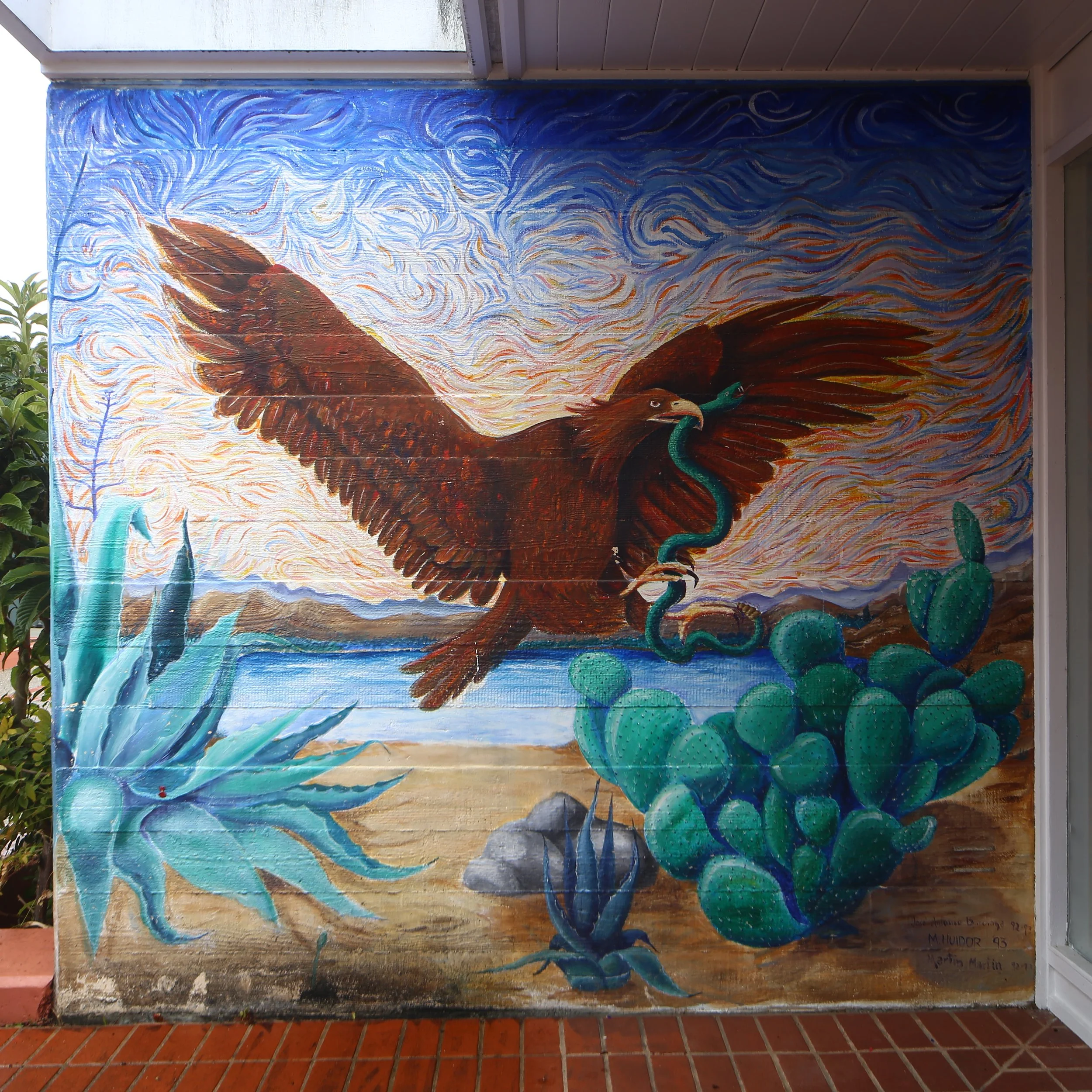
Founding of Aztlán depicts the culmination of the Mexica’s 200-year journey to find their new homeland. Prophetic guidance determined that the sight of an eagle with a snake landing on a cactus would herald their arrival, and this imagery is frequently used to invoke Aztlán as the mythic homeland of the Mexica or Aztecs. During the Chicano Civil Rights Movement, Aztlán served as both a conceptual anchor and generative frame for Mexican Americans engaged in the work of recuperating a sense of history, identity, and culture that was not determined by a US American assimilationist paradigm.
Although the eagle serves as the composition’s focal point, subtle details throughout Founding of Aztlán compel the viewer to linger. For example, the sky surrounding the eagle features expressive, swirling brushstrokes of blue, orange, and white colors arranged in a gradient, creating a dreamlike atmosphere. Additionally, the delicate rendering of the cacti’s spines imbues them with a trompe l’oeil effect. Most remarkable was the ability of the artists to achieve these effects while painting on a heavily-textured surface.
Made by a resident professional artist and students on the exterior of the Casa Zapata dormitory, the mural serves as a visual symbol of students’ arrival at their own mythic home. When the group began painting in 1992, numerous artists, activists, and thinkers were grappling with the ongoing legacy of colonialism as represented in the Columbus Quincentenary. Viewed in relation to Stanford University’s architectural environment, which evokes the grandeur of empire, Founding of Aztlán signals to viewers the existence of a space that subverts this imperative. –Mary Thomas
-
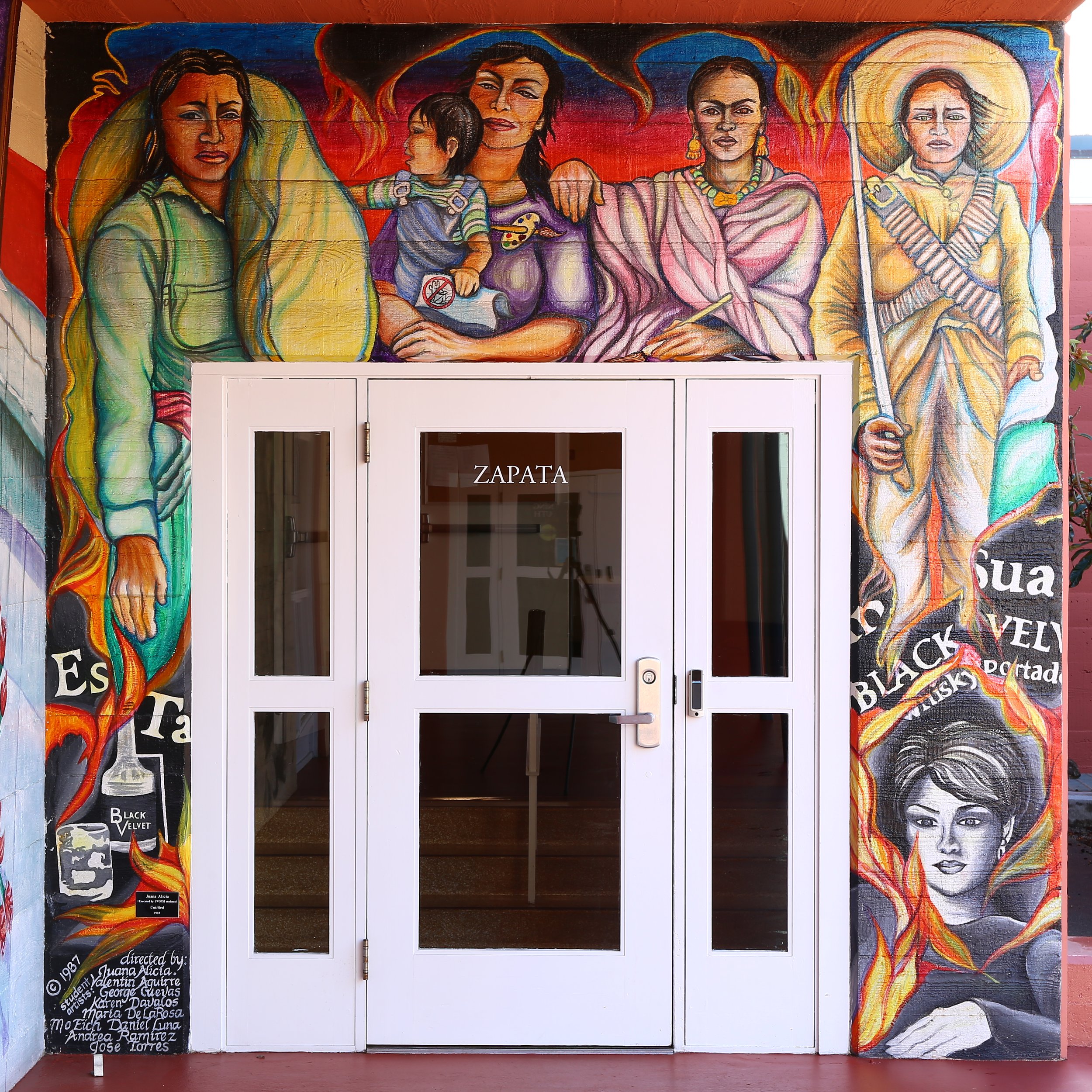
In preparation for Mujeres de Fuego, students conducted research for artist Juana Alicia and surveyed peers about the imagery they felt was needed at Casa Zapata. The artist and students then created a mural that surrounds an entrance for the dormitory and included subject matter that celebrates women laborers, artists, and revolutionaries from both Mexico and the United States.
Beginning at the top-left of the mural, the artists painted an anonymous farmworker or cottonpicker carrying a large, seemingly heavy bag over her shoulder. Next to her stands the San Francisco-based Chicana artist Yolanda M. López, who holds her young son Río Yañez. In his hand, Yañez holds a folded piece of paper with a drawing that crosses out a sleeping Mexican caricature, which seems to reference López’s multimedia installation Things I Never Told My Son About Being a Mexican (1985) and her critiques of stereotypes found in various goods and souvenirs. Mexican artist Frida Kahlo is shown resting her hand on López’s shoulder, suggesting a symbolic connection between the two women artists. To the right of Kahlo, stands a painted portrait of Adela Valverde Pérez, also known as “Adelita,” which is based on the famous photograph of the soldadera taken by Agustín Casasola during the Mexican Revolution (1910-20). Thus, Mujeres de Fuego uplifts Mexican women and Chicanas, past and present.
The bottom of the composition portrays an additional anonymous woman. Painted in black and white, a distinct contrast from the vibrant array of colors used in the portraits above, her piercing stare confronts the viewer as yellow, orange-red flames surround her and emanate from the edges of the composition. The fire burns a Black Velvet Whiskey advertisement, a brand of liquor that is represented via text, a labeled bottle, and an old-fashioned lowball glass filled with liquid and ice. When read along with the women heroes above, the anonymous woman or “Black Velvet Lady,” transforms from a mere component of an advertisement to one who joins the others as empowered protagonists who ignite the flames of female perseverance in the face of a culture that too often aims to devalue them. –Gabriela Rodriguez-Gomez and Rose Salseda
-
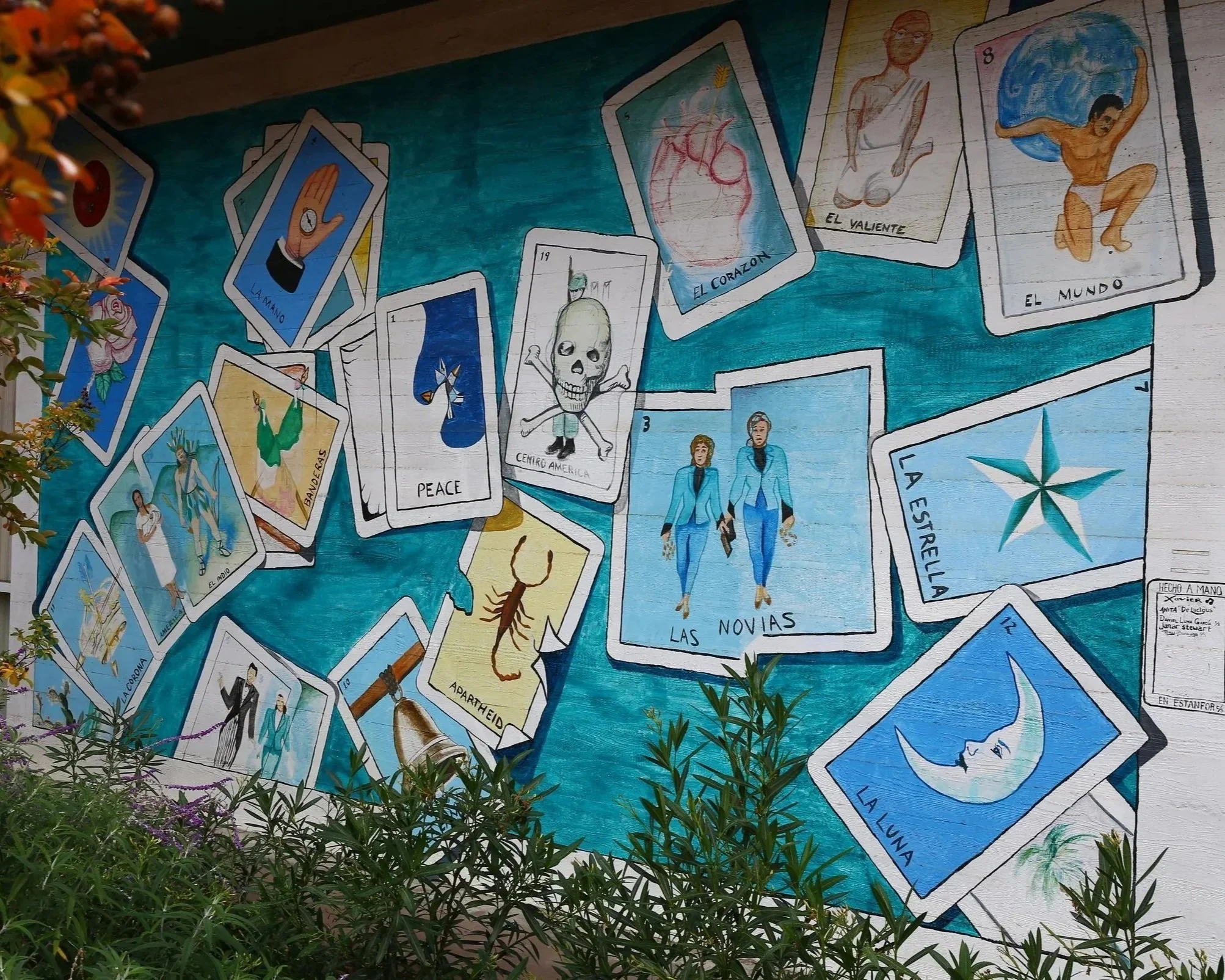
Students worked on Lotería Chicana under the guidance of Ray Patlán, with support from José Antonio Burciaga, as part of the first Stanford Workshop on Social and Political Issues (SWOPSI) class that Patlán led in 1988. The mural features an array of cards inspired by imagery commonly seen in lotería, a game similar to bingo that originated in Mexico. The imagery in traditional lotería decks includes everyday objects and symbolic archetypes, such as the figure of Atlas holding the weight of the world for the “El Mundo” card. The traditional illustrations have also depicted racist, classist, and sexist stereotypes and caricatures.
Due to the ongoing popularity of lotería and the familiarity that many students had with the imagery, the cards provided a shared visual language that served as a starting point for developing new motifs. Thus, Lotería Chicana reflects student interest in developing new imagery that was relevant to their experience and reflected their concerns. In fact, many Chicano artists have adapted lotería imagery to create visually-impactful political statements, such as Victor Ochoa, whose Lotería Fronteriza mural was displayed outside of Galeria de la Raza in San Francisco in 1985. The mural replaced traditional lotería imagery with references to the experience of crossing the U.S.-Mexico border, such as with the artist’s replacement of the traditional masculine figure of “El Valiente” with a woman bursting through a fence. His reimagined “La Valiente” thus counteracts gender and media stereotypes of immigrant women by emphasizing their bravery and strength. In Lotería Chicana, students also reimagined “El Valiente” by depicting him as Mahatma Gandhi, who led India’s campaign for independence from British rule through nonviolent resistance.
Students reimagined and modernized many additional cards. For instance, two cards labeled as “Las Novias,” or girlfriends, depict two women holding hands, which suggest a same-sex couple. Students also referenced the cultural and ethnic mestizaje that many Mexican Americans and other Latinos experience by depicting the figures of “El Indio” and “La America” together, with America holding a baby. For the cards depicting couples, the artists also merged their backgrounds and disintegrated their borders, further suggesting the literal reconfiguration and re-creation of the symbols and identities.
Additionally, Lotería Chicana references antiwar and global movements for justice at the time. For example, the “Paz” card depicts a dove with missiles in its mouth, suggesting that the achievement of peace occurs through demilitarization. The card depicting a scorpion invokes apartheid as its label, referring to the practice in South Africa as venomous. Yet, the inclusion of the card also recognized the global solidarity movement aimed at divesting from and dismantling apartheid, of which many Stanford students participated. Another card, titled “Centro America,” represents a soldier behind a skull, a reference to the violence spurred by the U.S.-backed interventions throughout Central America.
In 2021, after the university began to resume in-person instruction after the closures caused by the COVID-19 Pandemic, the last two cards were whitewashed. The anonymous censor(s) painted over the antiwar imagery of the “Centro America” card. The text reading “Apartheid” was erased, too; yet, the scorpion was left intact. –Mary Thomas and Rose Salseda
-
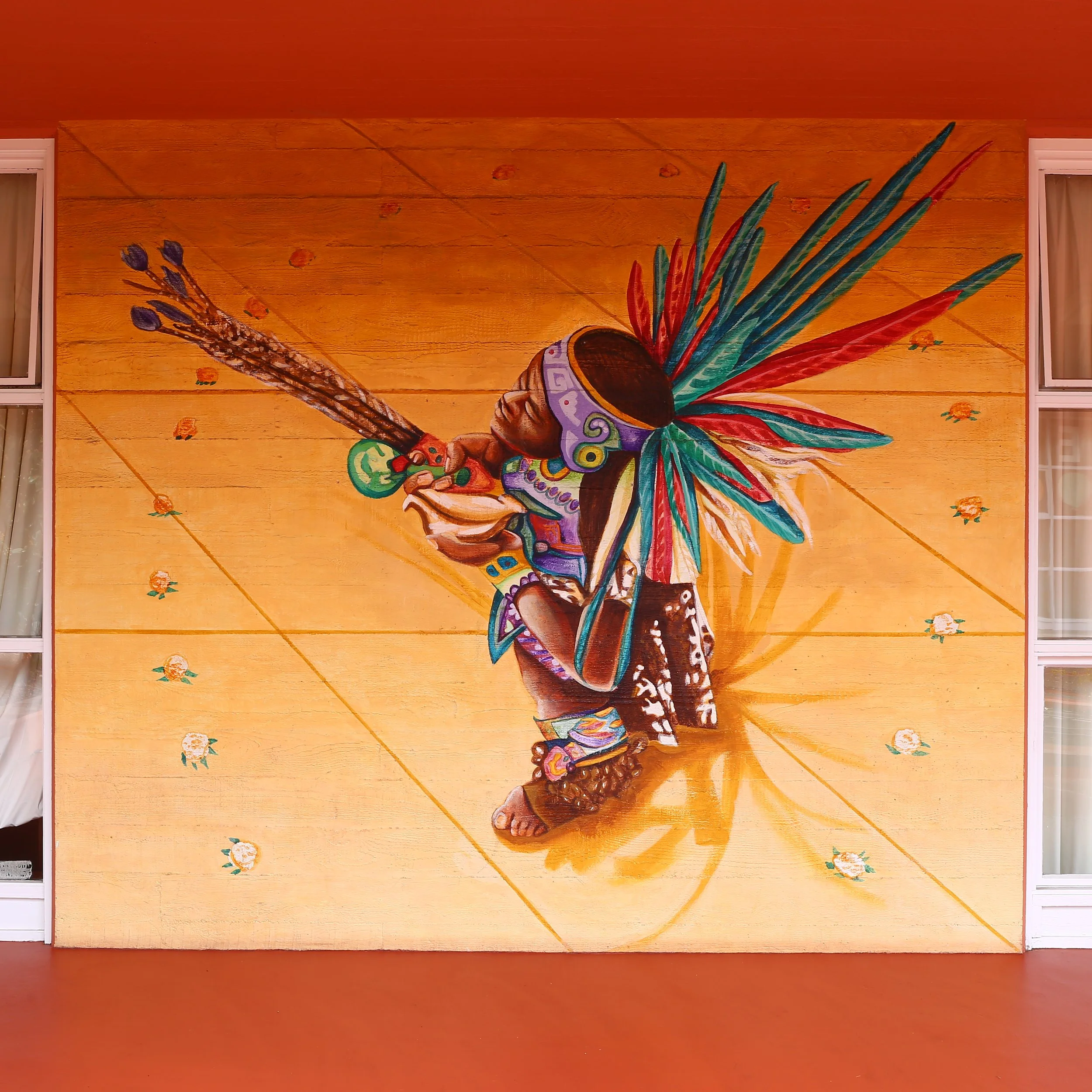
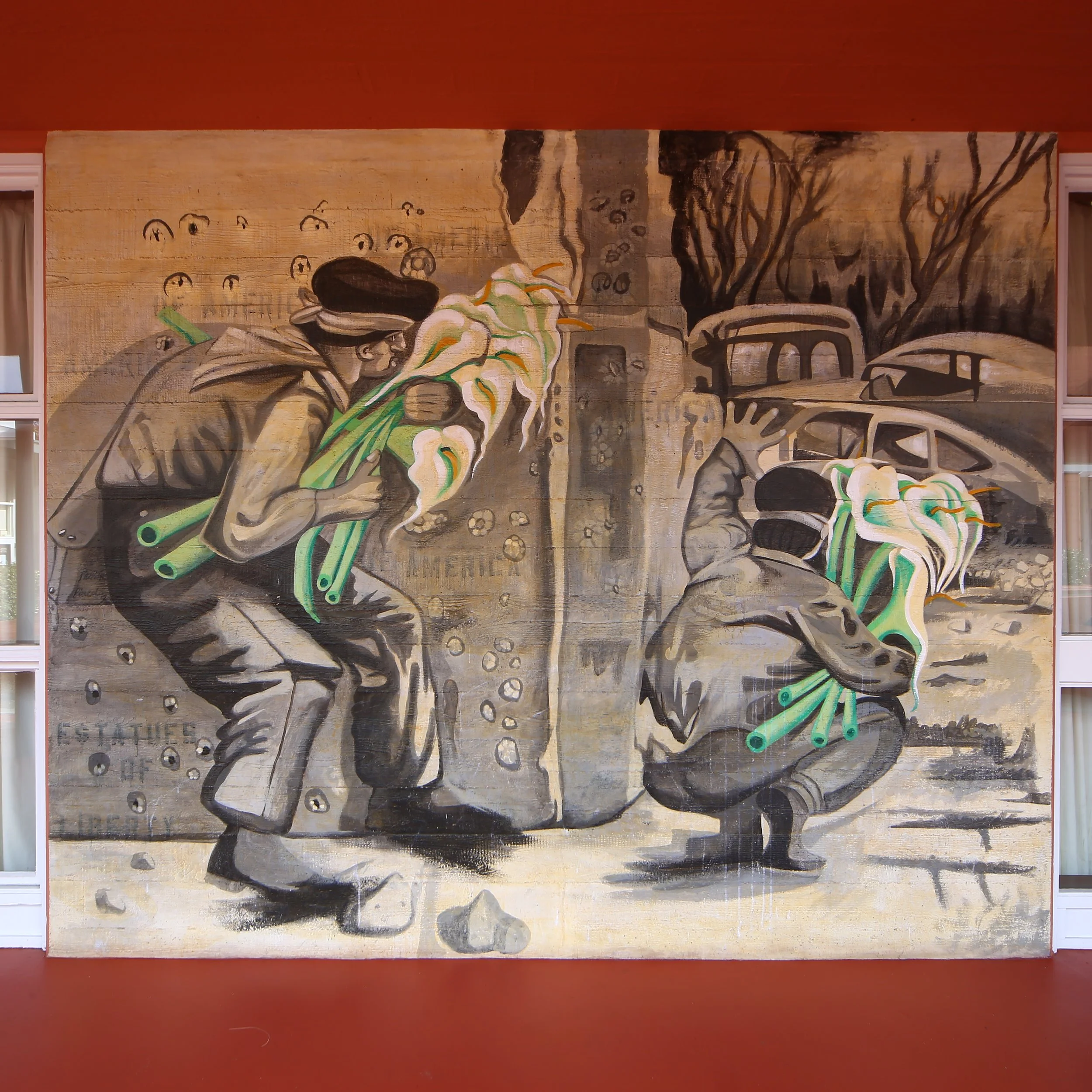
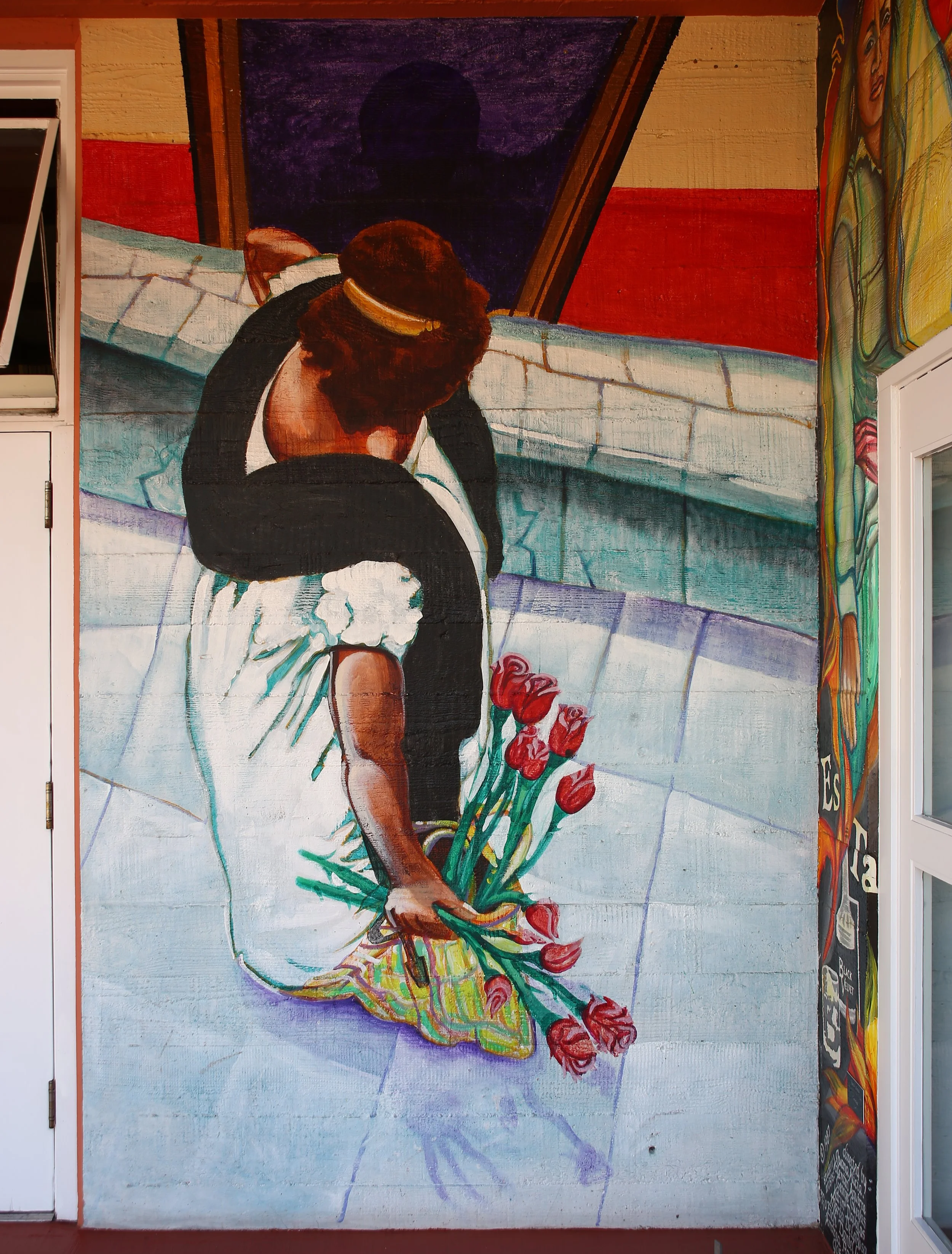
The triptych mural Estatutes of Liberty, conceived by artists Ray Patlán and Eduardo Pineda, responds to liberation struggles not only within Chicano/a communities but also across global contexts, including Lebanon and Central America. Its title is a deliberate linguistic hybrid that merges “Statue of Liberty” and the Spanish estatutos (laws), creating a neologism that challenges the contradictions of U.S. American ideals. Through this bilingual wordplay, the artists critique how justice and freedom are selectively applied, especially to immigrants, communities of color, and those marginalized by others. As an introduction to the mural’s layered meanings, the title itself invites viewers to reconsider how liberty truly serves the U.S. American socio-political landscape.
The first panel of the mural, located on the left side, depicts an Aztec dancer engaged in a ceremonial act, blowing a conch shell as part of a spiritual ritual meant to summon the community and initiate a collective gathering. Surrounding the dancer are bright orange marigold flowers, or cempasúchil. In both contemporary Mexican culture and pre-Columbian Aztec tradition, marigolds are known as the “flower of the dead,” used to honor the spirits of ancestors during Día de los Muertos, and believed to guide souls with their vivid colors and strong scents. Their presence in the mural evokes this layered cultural memory, linking the act of ceremony to both Indigenous cosmology and ongoing ritual practices rooted in Mexico and the Chicana/o Movement.
The central panel of the mural is based on an Associated Press photograph taken during Lebanon’s civil war (1975-90) that depicted two urban guerrilla fighters. In the mural, their rifles are intentionally replaced with white calla lilies, creating a powerful act of counter-imagery that transforms a symbol of violence into one of peace and reflection. This substitution can be interpreted as a rejection of war, a tribute to the fallen, and a gesture of hope and renewal in the face of destruction. In addition to their associations with mourning and remembrance, calla lilies hold more profound meaning in Latin American artistic traditions. For example, in the work of Diego Rivera, femininity, beauty, dignity, labor, and womanhood are all represented via the calla lily.
The third panel on the right reproduces a 1984 mural by Ray Patlán, first created in San Francisco’s Mission District as part of PLACA, a muralist collective committed to supporting Central American liberation struggles. Drawing inspiration from Camino al Mercado, co-conceived with Francisco X. Camplís who attended Stanford in the 1970s, the mural highlights the role of Central American women in revolutionary struggles. In the original mural, two women appear to be walking to market, but hidden beneath their rebozos are assault rifles, suggesting their roles as guerrilleras and challenging traditional gender roles. This blending of domestic and militant critiques challenges imperialism and foregrounds the often-overlooked contributions of women to the Salvadoran and Nicaraguan revolutions. In the Casa Zapata version, the scene features a woman passing a doorway where the shadow of a soldier looms, and a gun is subtly tucked among the roses in her handbag, continuing the theme of covert resistance. –Mauricio E. Ramírez
Selection of Interior Murals
-
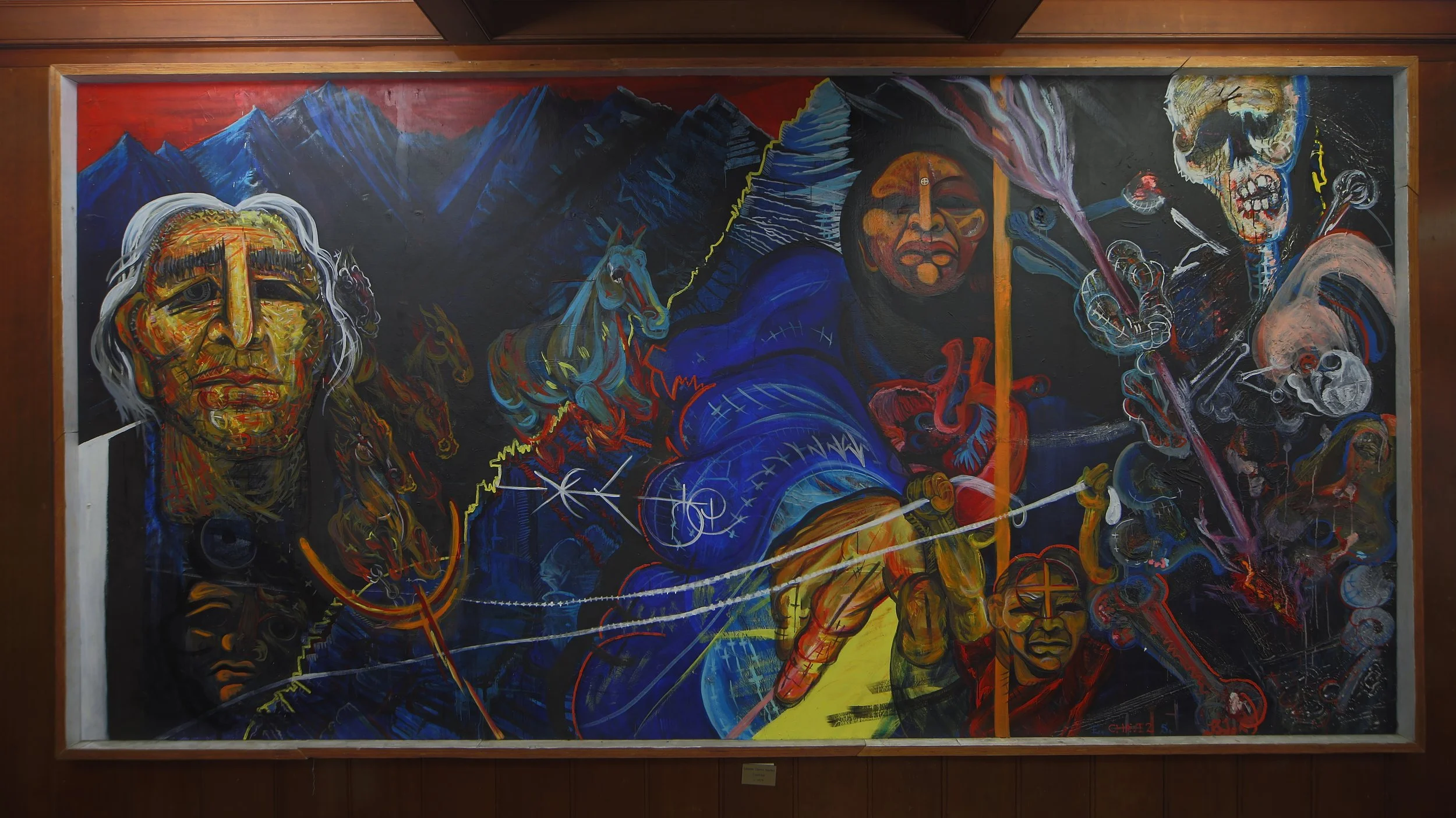
Native American Roots places a series of female figures against a backdrop of blue mountains positioned against a red sky. The figures are comparable in scale to the mountains behind them and, throughout the painting, Chavez deploys expressive brushwork and abstracted forms to create a dynamic and enigmatic composition. The composition’s left side features two figures: one with long, white hair and a weathered face and, positioned beneath and cast in shadow, a smaller, perhaps younger face. Immediately, to their right, a trio of brown horses emerge from the darkness, led by a luminous blue horse that appears to gallop over a line of flames tracing the blue mountain ridge. The ridge shifts into the voluminous sleeve and torso of a woman, who appears to concentrate her gaze at the viewer and points with an outstretched hand. The artist then painted a series of abstracted forms in orange and white across the composition, which connect the figures, including a small androgynous figure near the bottom right with arms raised and grasping onto white brushstrokes like a pair of reins. A bold orange line separates the small figure from the woman, and the right edge of the composition features a pair of skeletons: a mother, with nails driven into her skull, who is nursing a child.
According to an archival document that analyzed the murals in Casa Zapata, Native American Roots speaks to the inescapability of oppression. The mural’s compositional organization uses two triangles, formed by the mountain peaks, and a rectangle, demarcated by the orange line. The person with raised hands serves as a visual representation of anguish, and the white lines that they hold connect them to the thematic elements of ancestry (symbolized by the figure with white hair), life (the horses that break through the mountain ridges), and strength (illustrated by the woman’s heart). The skeletal forms directly reference death, and the figure with raised arms seeks to grasp onto strength, life force, and ancestry, despite death’s approach. –Mary Thomas
-
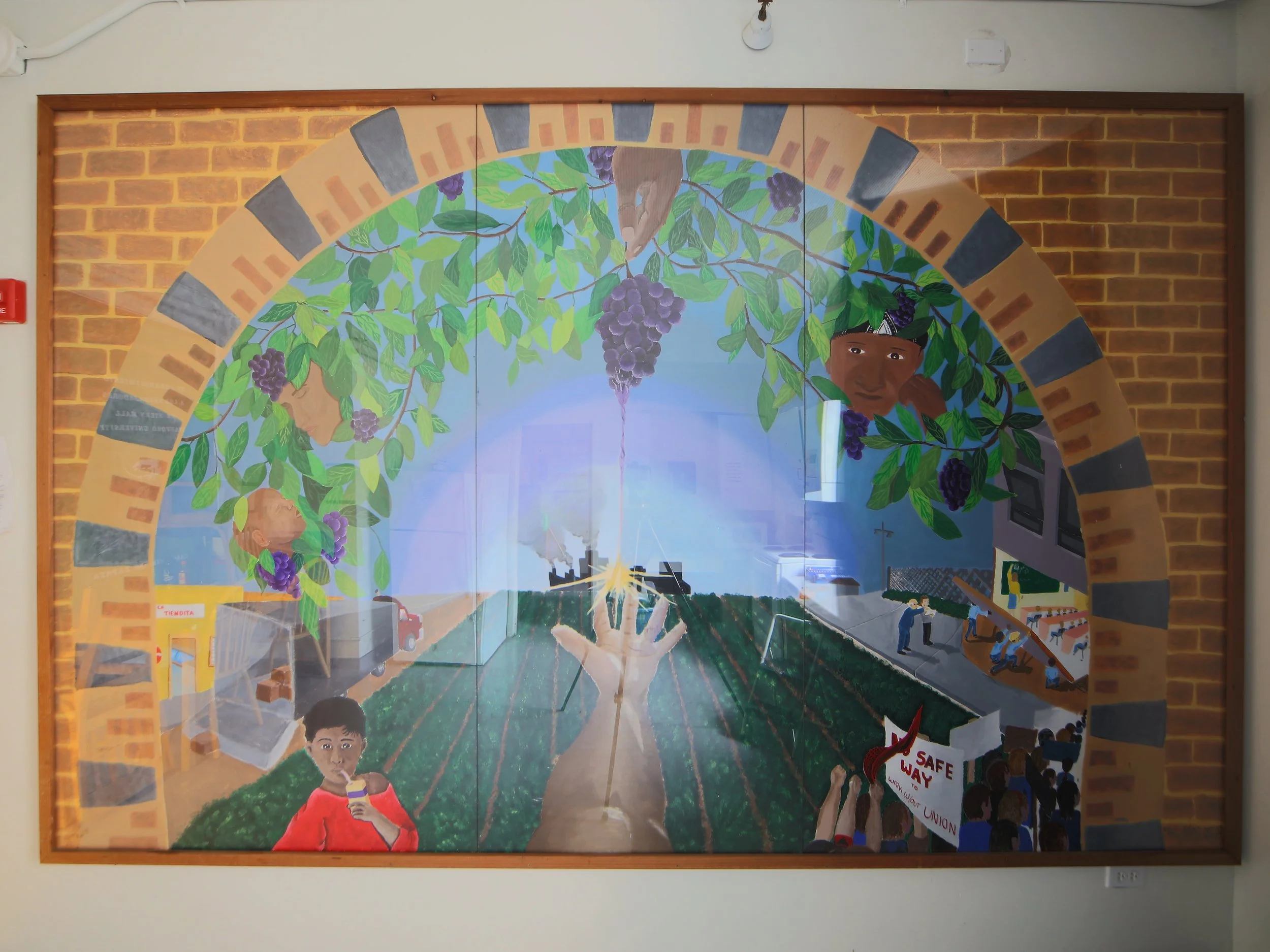
An outstretched hand, near life-size, gestures toward an expansive field of crops. A spark ignites between two fingers, and a line draws the viewer’s eye up to juice dripping from a cluster of purple grapes held by another hand. The outstretched hand and spark serve as the focal point of a composition that suggests how the farmworker struggle for just labor conditions is intertwined with the experiences of Stanford students.
Framing the composition is a stone archway, reminiscent of Stanford’s architecture, and vines that grow both grapes and human faces. Below, pollution bellows from a distant factory and, in the foreground, a child sips from a juice box as a truck unloads boxes into a store. On the bottom right of the composition, a cluster of protestors raise their fists with a sign that reads, “No Safe Way to Work W/Out Union.” Nearby, a group of laborers in blue uniforms raise a wall of a classroom while two men, one wearing a suit and another holding papers, observe the construction. One of the laborers wears a conical hat, a seeming reference to the Chinese laborers who constructed both the campus and the transcontinental railroads, which became emblematic of the Stanford family’s wealth and power. Further distinguishing the laborers are their darker complexions in comparison to the two overseers, suggesting both the university’s historic exclusion of people of color from the student population and its reliance on their labor.
The artists’ use of the arch as a framing device and the near-life scale of the outstretched hand break the illusion that the piece depicts a self-contained world. Instead, it appears as if the viewer could step into the scene, collapsing the perceived distance between the viewer, the painted subjects, and the conditions that they face.
Although other murals within Casa Zapata also speak to a solidarity between students and laborers, this painting’s thematic focus on grapes conjures the history of the 1994 student-led hunger strike at Stanford, which followed a series of events that included racist backlash to a film screening about farmworker labor conditions and the surprising layoff of Cecilia Burciaga, a popular high-ranking Chicana administrator and resident fellow at Casa Zapata. The hunger strike, which garnered support from faculty and coalitions of underrepresented students, ended when the university agreed to form committees to explore the creation of a Chicano Studies department, a campus-wide ban on purchasing grapes, and strengthen community relations with East Palo Alto, a largely working class Black and Latino neighborhood.
Although the painting’s title and exact date of creation are unknown, the three student artists included their signatures near the painting and marked their graduating year as 2007, confirming that they painted the artwork approximately one decade after the 1994 hunger strike. –Mary Thomas
-
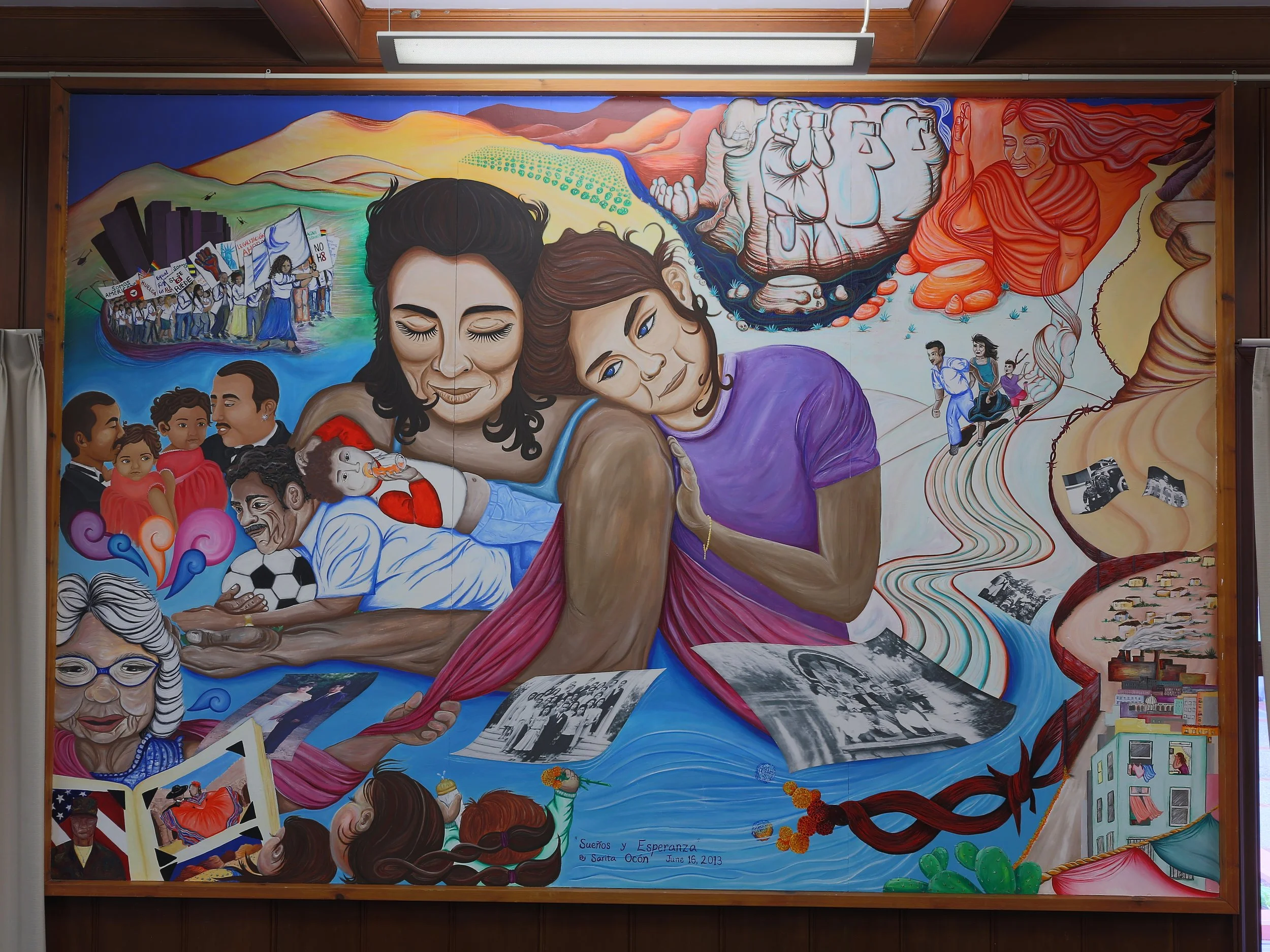
During Sarita Ocón’s senior year in 2003, Sueños y Esperanza became a student-led collaboration that focused on familia and conveyed a story of migration and social justice. At the painting’s center are two prominent figures of a mother and daughter who lovingly pose together. The daughter, who features Ocón’s brown hair and blue eyes, gazes toward her grandmother on the bottom left corner. In front of the grandmother is an open photo album, and her slightly open mouth suggests she is recalling family memories to the three grandchildren who look at the photographs with her. The grandmother’s magenta rebozo or shawl wraps around her outstretched arm and weaves across the composition as photographs seem to fly out of the album to follow its path. The floating photographs stand out for their realism. Using black & white family photographs, Ocón digitally manipulated them to appear as if they were in motion and then printed them onto canvas before adhering them seemlessly onto the wood panel. Together, the rebozo and photos connect various vignettes of families and political activism, including the depiction of two homosexual fathers who hold their young children, based on contemporary news coverage of a similar family, and the 2005 May Day March, characterized by the crowds’ white T-shirts and protest signs for immigrant rights. These signs also include other messages for justice, including those from the United Farm Workers, the Chicano Movement, and the NoH8 Campaign in addition to rainbow and American flags. On the right of the painting, the reboso’s multicolored threads unravel to become a rainbow pathway for a family crossing the U.S.-Mexico border before transforming into the figure of a woman, perhaps a younger version of the grandmother, who holds up her hand to block the surveillance of border patrol officers. On the far right, a rust-colored fence and barbed wire separates the land and beach, yet the end of the barbed wire transforms into marigolds that waves carry toward the grandmother and children. The youngest child grasps onto the flowers tightly, suggesting how the family’s memories, as well as their hopes and dreams for a better future, will persevere in the next generation. –Gabriela Rodriguez-Gomez and Rose Salseda
-
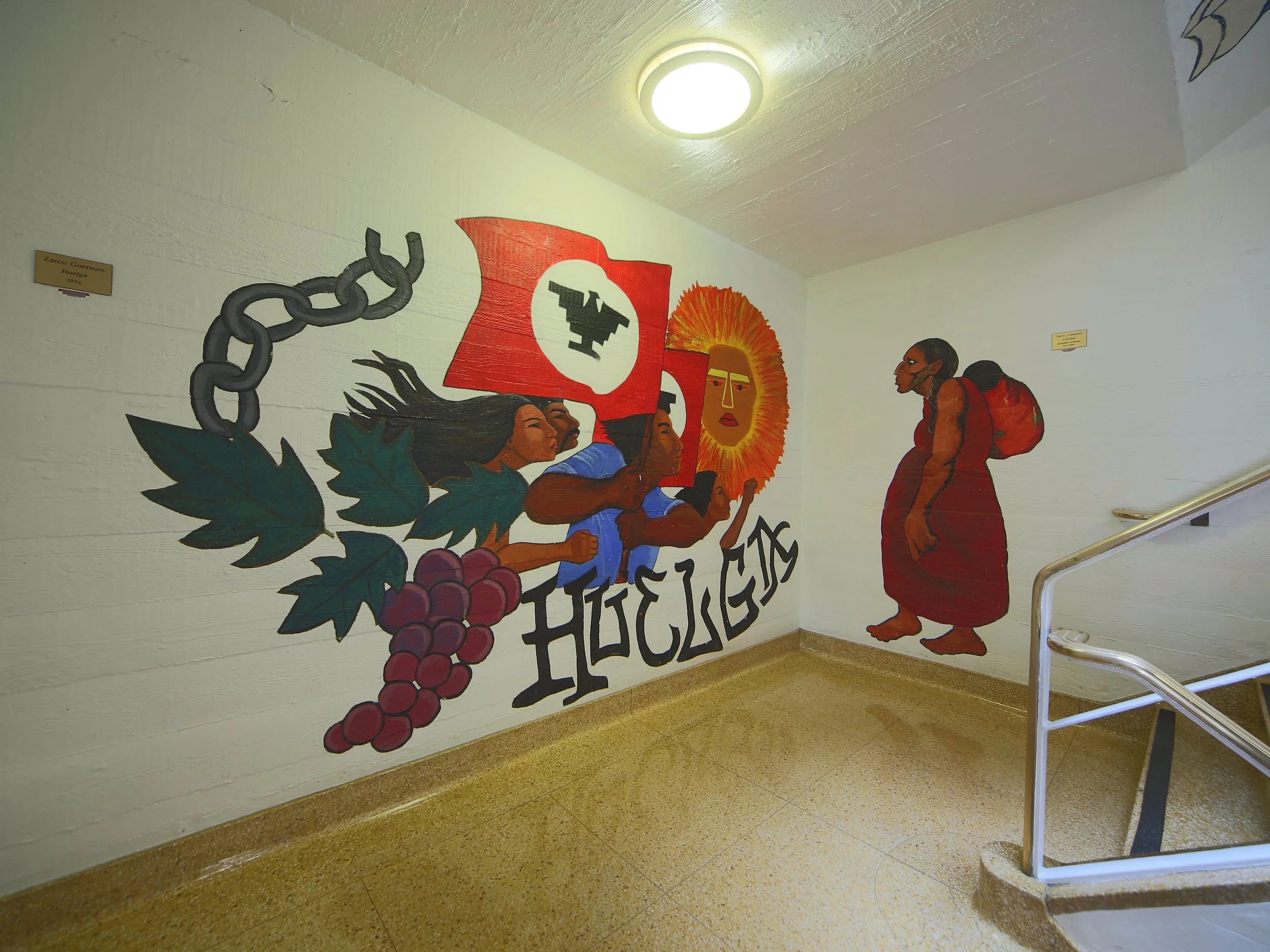
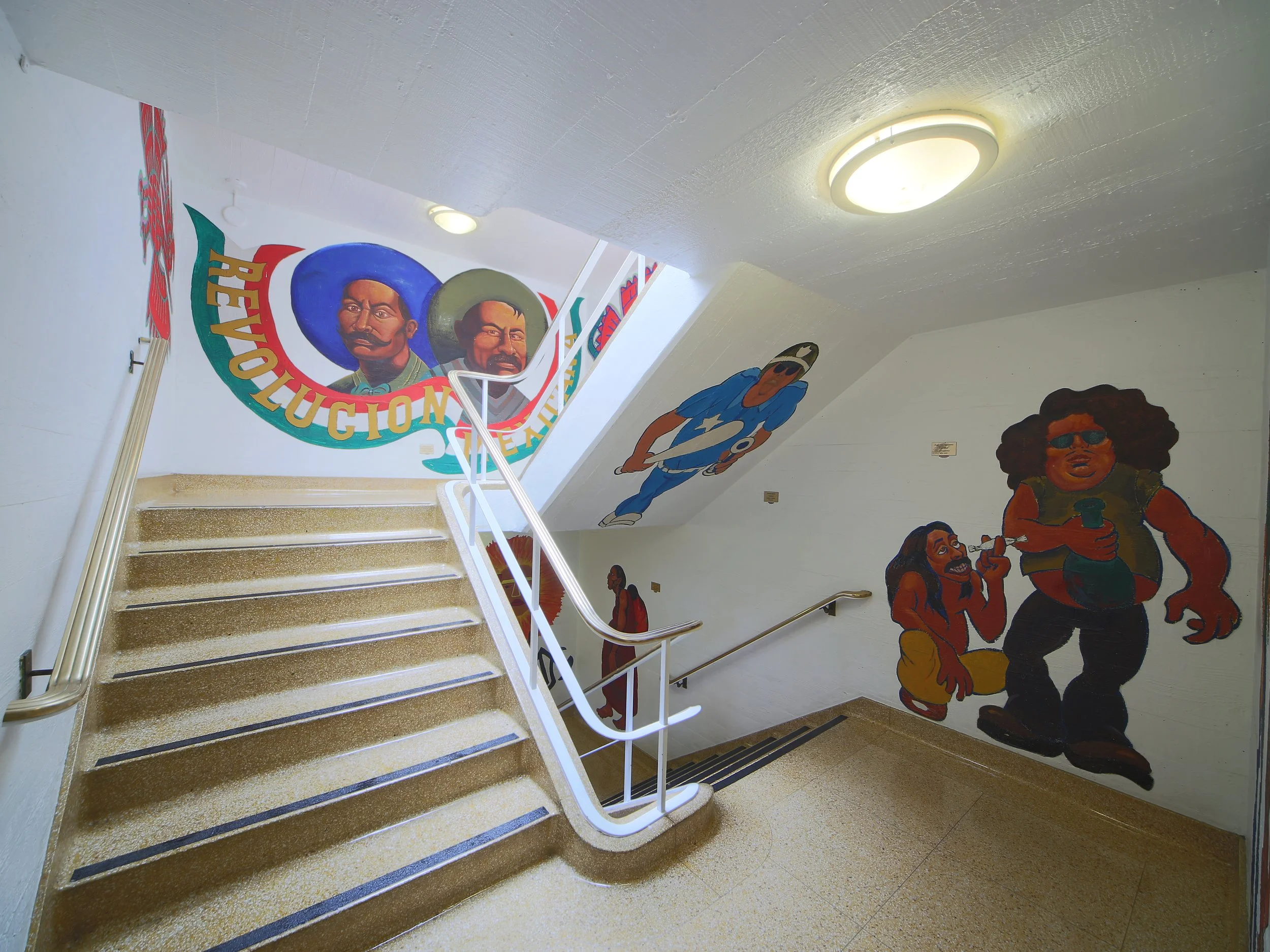
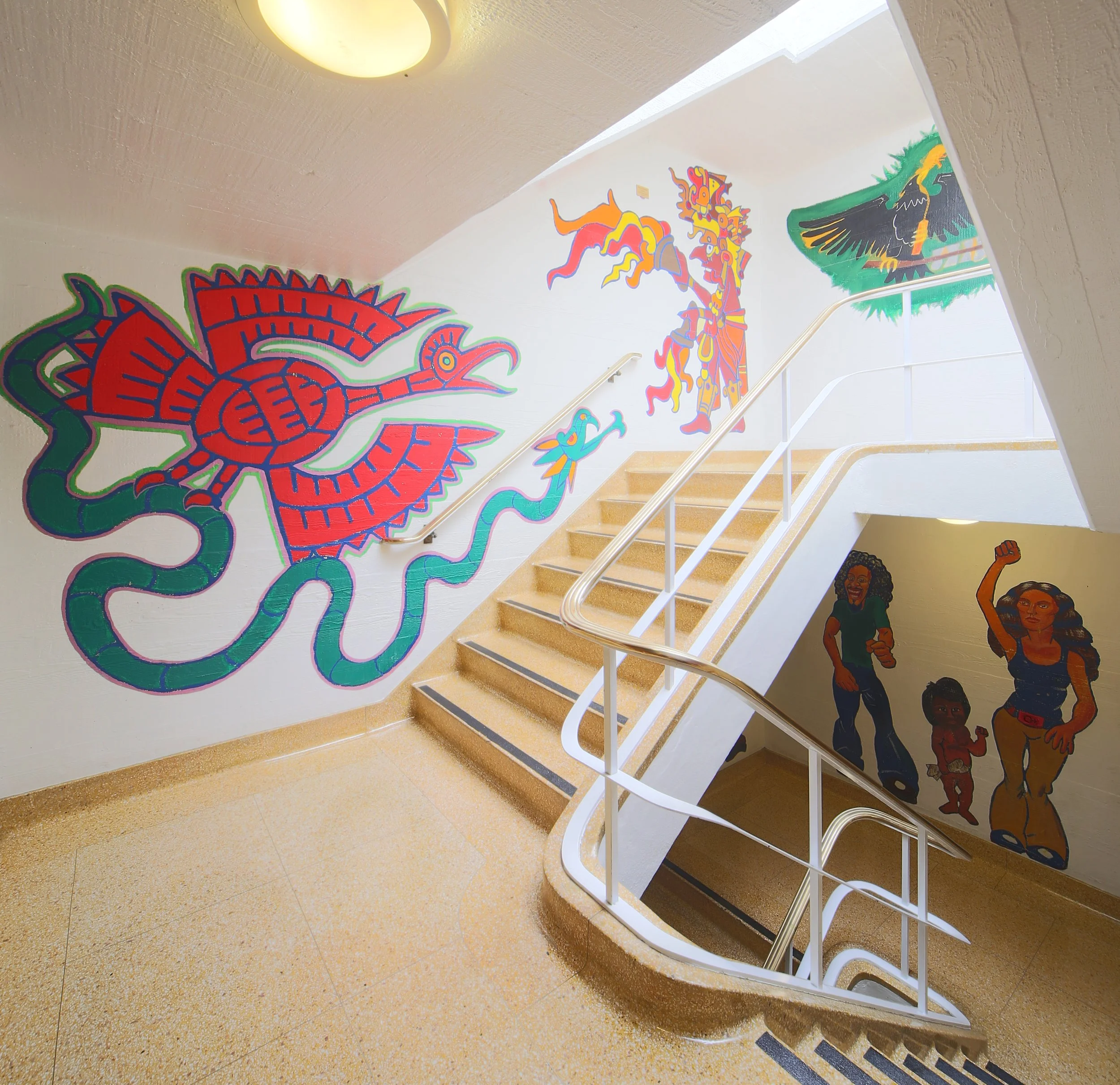
During the early 1970s, Zarco Guerrero and unknown students painted murals in the Casa Zapata stairwell that drew upon themes and imagery prominent during the Chicano Civil Rights Movement. Huelga, which appears at the base of the stairwell, features a vignette of a dynamic grouping of figures holding United Farm Worker flags while surrounded by broken chains, a cluster of grapes, and an anthropomorphized sun. Guerrero depicted the four figures in profile, and the rendering of them in motion creates the illusion of forward momentum as the piece reaches the natural edge of the wall. Peasant Woman, which depicts a woman as if she is descending the stairwell, disrupts this sense of momentum as the viewer ascends the stairs.
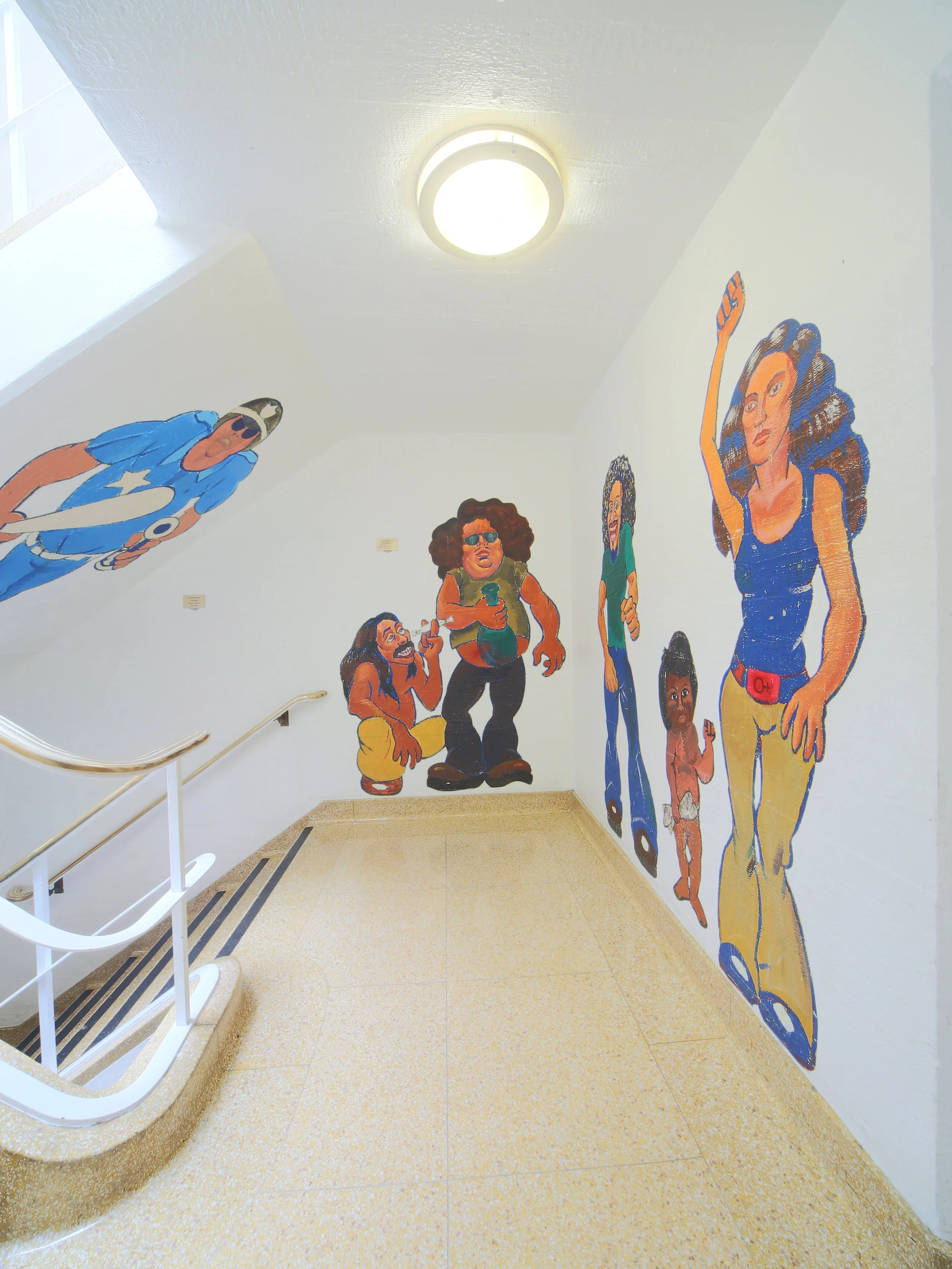
Also painted on the second floor landing is a group of caricatured figures, comprising four men, one woman, and a small child. The artist depicted one man holding a joint and another poised to swig from a bottle. The woman appears relatively somber, with a fist raised in the air and the “female” symbol painted onto her belt buckle.
In the decades following the painting of this mural, it had been subject to criticism by student residents of Casa Zapata who felt the figures were inappropriate representations. In a video tour of the murals, Burciaga directly comments on this critique, explaining that the figures are representative of the first generations of Chicano students to attend Stanford and that their appearance functioned as a political statement against institutional assimilation. Another part of the same mural, painted on the underside of the stairwell, depicted a police officer who faced the Chicano figures.
In 2021, after the COVID-19 Pandemic closures, the officer was whitewashed anonymously, thus erasing an important component that underscored the tension inherent in existing within a predominantly white and elitist institution. In the video tour, Burciaga further reveals that the Chicano figures originally had speech bubbles that read, “Arriba y adelante, juntos.” The message spoke to the political subtext of the mural and expressed an empowering ethos of rising up and moving forward together, especially when facing oppression as symbolized by the officer. In the early 1990s, facility workers covered the message when repainting the stairwell and, although Burciaga mentioned a plan to repaint the message, the project was never completed. –Mary Thomas
© 2026 Rose Salseda