Stern Dining Hall
Dining room for the Casa Zapata dormitory with 3 murals and large-scale paintings
-
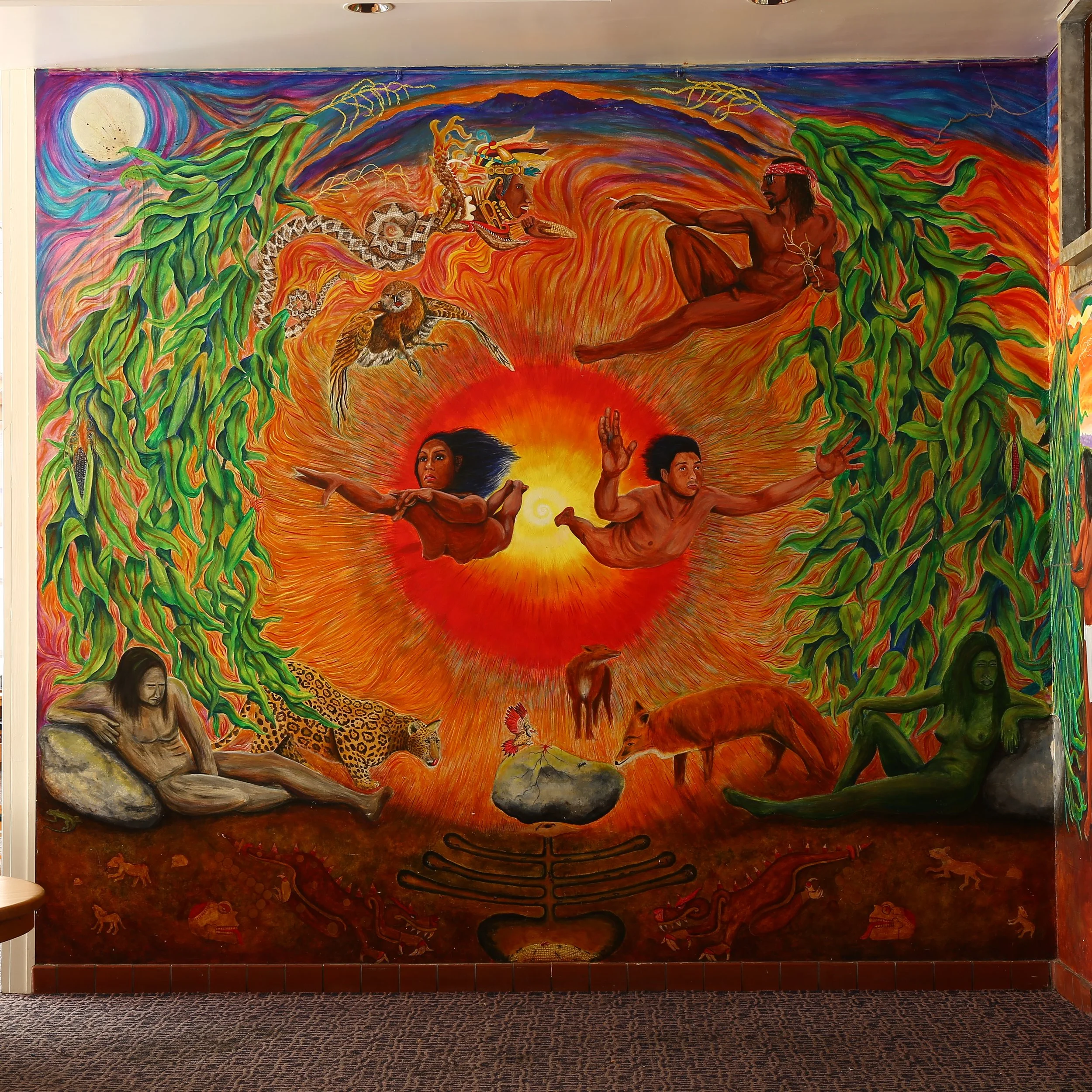
The Mythology and History of Maíz comprises three murals that use the motif of corn to capture a narrative cycle of creation, life, and rebirth. In “The Mythology of Maíz,”located on the left wall, Burciaga introduces viewers to the motif and the creation myths found in the Mayan Popol Vuh and the Aztec and Nahua Legend of the Five Suns. Framing the mural are stalks of corn, the first attempts to create human life, and various animals and insects from the mythologies. The portrayal of a woman and man flying out from a glowing sun underscores their successful creation. Above them, Burciaga humorously reimagines Michelangelo’s Sistine Chapel ceiling (1508-12). Instead of God giving life to Adam, the artist portrayed the Aztec deity Quetzalcoatl offering an ear of corn to a vato donning a bandana and sunglasses. To reciprocate, the vato passes the deity a hand rolled cigarette.
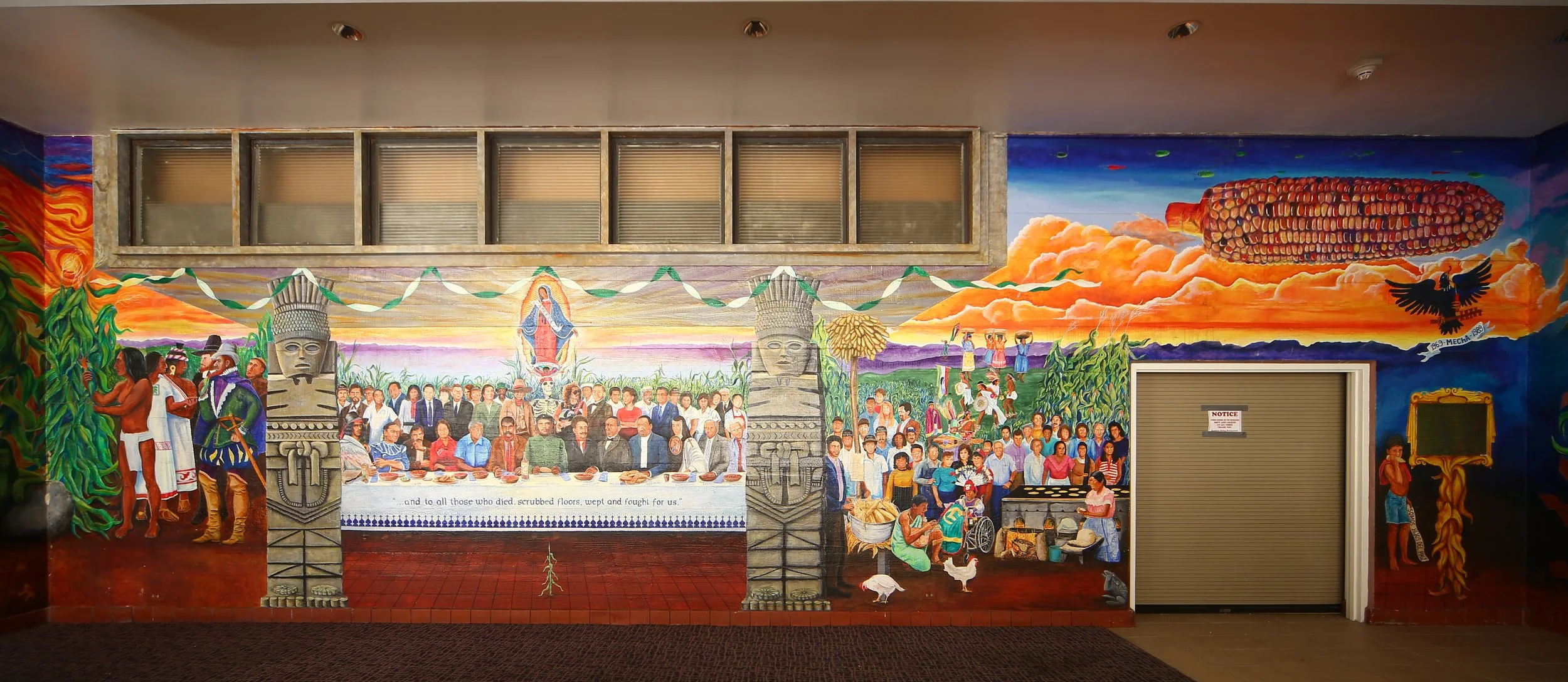
In preparation for the central panel, Burciaga surveyed 100 students and 100 community members asking them, “Who are your Chicano heroes?” He then filled the table and surrounding areas with portraits drawn from the survey results: revolutionaries, activists, artists, politicians, and religious figures, such as Emiliano Zapata, Ernesto “Ché” Guevara, Dolores Huerta, Rev. Dr. Martin Luther King, Jr., Frida Kahlo, and Sor Juana Inéz de la Cruz. A reimination of Leonardo DaVinci’s The Last Supper (1495-98), the figures share a meal of corn-based foods and drinks, like pozole, tamales, and atole. Behind them Burciaga included the portraits of additional well-known figures as well as Stern Dining Hall service workers, students, and community members. Presiding over everyone is Tonantzín, who many recognize as la Virgen de Guadalupe, and under her is la Muerte or death. On the tablecloth, Burciaga inscribed an edited quote from an anonymous student who answered that his heroes are “all the people who died, scrubbed floors, wept and fought so that I could be here at Stanford.” The quote, along with the many portraits included in the mural, underscore the numerous people needed to ensure students’ “seat at the table” of the university. Yet Burciaga edited the quote to change the individual “I” to the inclusive “us.”
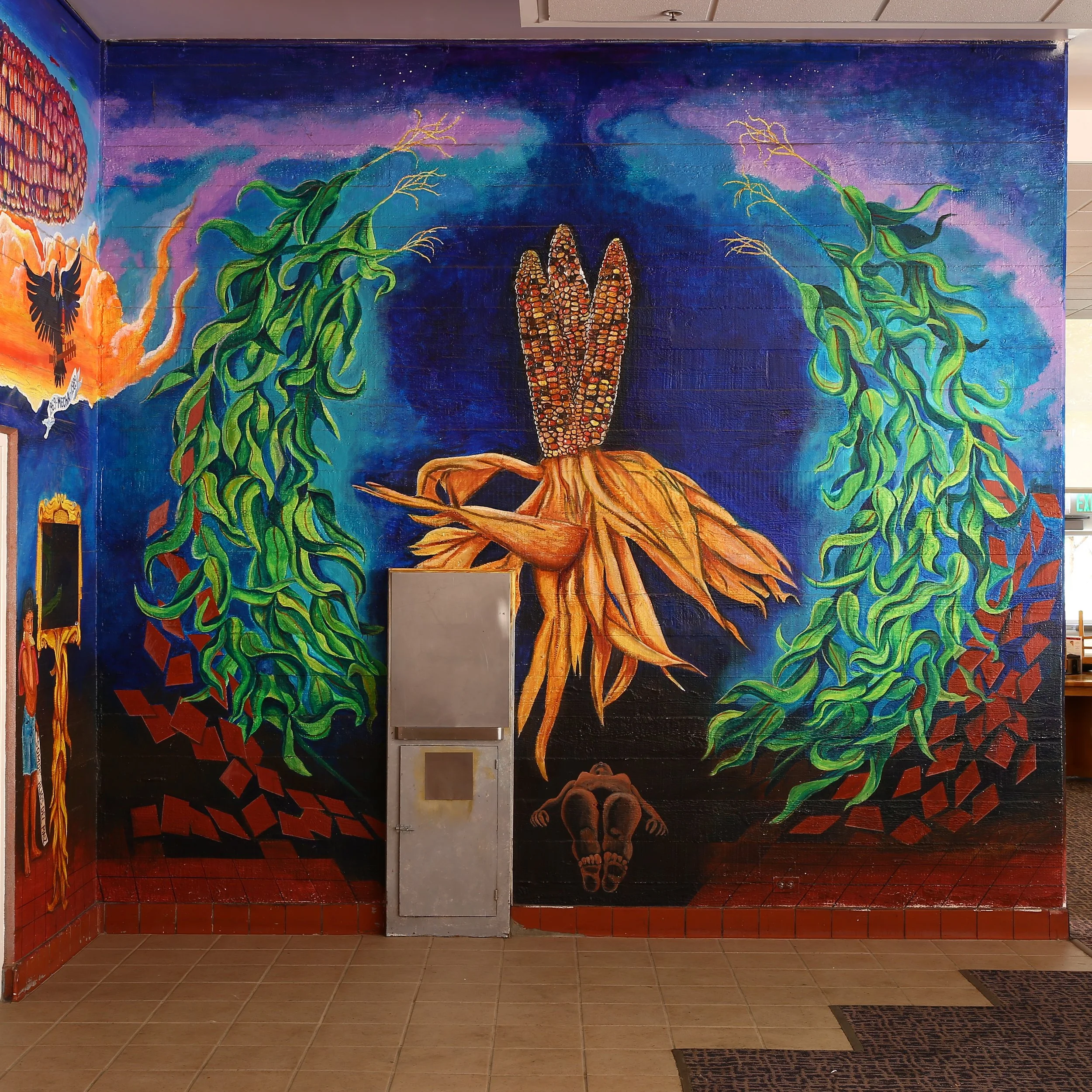
In “The Cycle of Life,” located on the right wall, cornstalks and an explosion of the dining hall’s historic burgundy tiles encircle a supine figure of a brown-skinned woman, perhaps the same woman pictured in the creation scene. Above her rises a triple ear of maíz whose multicolored kernels identify it as the Indigenous corn of the Americas. It is at once an important staple crop that sustained countless generations of people and a representation of Indigenous knowledge, creativity, and resilience, which Burciaga repeatedly represents across the three walls. Thus, the scene should not be read simply as one of death but, as the title of the panel suggests, one that signals the continuation of life. –Rose Salseda

-
Painted with bold acrylic paint colors on three conjoined wood panels, artist Zarco Guerrero depicts three striking portraits of anonymous women. The woman on the left is a brown-skinned mestiza or Chicana with jet-black hair, high-cheek bones, and a bright-white toothy smile; in the center is a faceless, peachy-pink colored silhouette with golden blonde hair; and, on the right side, is another brown-skinned woman but one who is elderly with wrinkles and silver-white hair. Guerrero placed all three women over a background painted with bright green on the left that blends into a deep cobalt blue on the right; meanwhile, he coated the top edge of the canvas in a vivid red color that is reminiscent of dripping blood.
In an essay written in 1974, Guerrero explains that he created the image as a “mirror”: the portraits of the younger and older women on the far right and left of the painting, represent Chicanos and Chicanas as well as those of other races, genders, and class. The artist further explains that the painting reflects on “Anglo images of beauty and culture [that have] been smuggled into the minds of all”–an image that is both “plastic and violent.” Embodying these latter ideas is the faceless blonde woman who corresponds to Guerrero’s reference of “Anglo-controlled media.” In the 1980s, José Antonio Burciaga, an artist and Casa Zapata Resident Fellow, reported on the artworks at the dorm and Stern Dining Hall. He interpreted the faceless portrait as representing a “mannequin wearing a blond wig,” which stands for the “unattainable Anglo image sold to the Chicana/o population in both the U.S. and Mexico.” Indeed, the gaze of the elderly woman confronts that of the viewer, and her slightly open mouth and raised hand suggests she is generating a response to being the subject of a racist standard. Then, returning to Guerrero’s representation of the younger woman, we might interpret her portrait as an act of self-determination that also identifies her as beautiful. –Gabriela Rodriguez-Gomez
-
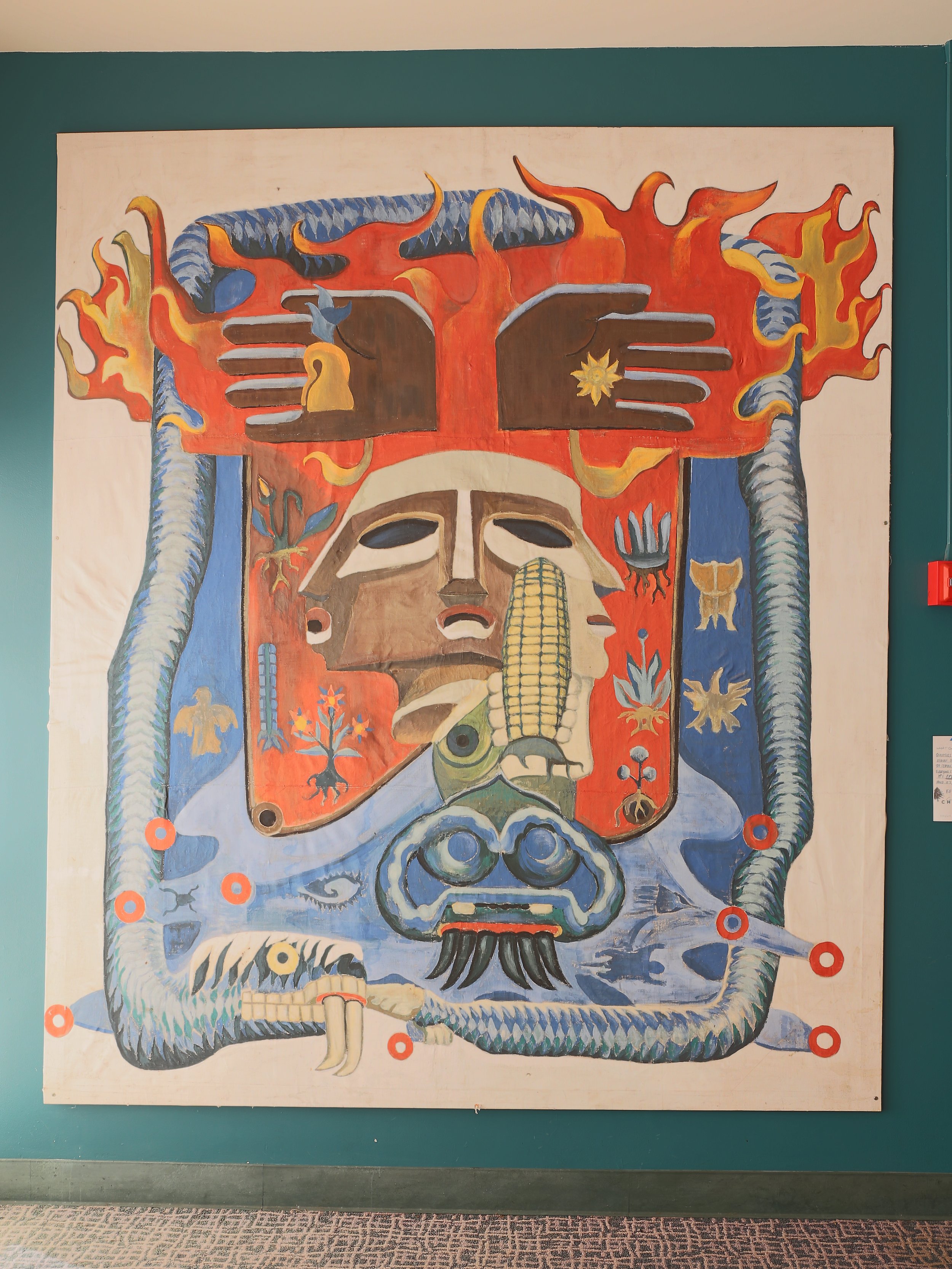
The anonymous artist who reproduced Francisco Eppens’s la vida, la muerte, el mestizaje, y los cuatro elementos (1953–54), a large-scale mosaic tile mural located on the façade of the medical school at the National Autonomous University of Mexico, demonstrates attention to detail by approximating the original design. Moreover, an early painting to appear in the emerging art collection of Casa Zapata, its focus on the Aztec deity Coatlicue, known as the mother of Huitzilopochtli and other gods in the Aztec pantheon, underscores students’ interests in reviving the links to a pre-Columbian history. Coatlicue’s image embodies the duality between life and death, a central theme of Aztec beliefs. At the center of the painted canvas, a trifacial head portrays a brown-colored Indigenous mother on the left and a beige-colored European father on the right. Between them, their mestizo child represents the results of mestizaje, or the blending of different races, ethnicities, and cultures, which is emphasized by the large oblong eyes that stretch out to unite all three faces. Further representing creation is the Aztec deity Coatlicue, whose large breasts frame the faces and include various icons of plantlife. Placed above are open-palmed hands, likely drawn from other representations of Coatlicue’s distinctive hand, heart, and skull necklace. The hands hold a solar symbol that signifies pollen and a germinated seed, emphasizing reproduction and the life cycle. Meanwhile, just below the faces, a skull, again likely referencing the necklace, devours a corncob whole, emphasizing the duality of life and death. The artwork also includes symbols to represent an elemental theme that comprises the earth, as represented by Coatlicue’s breasts and botanicals; the sun, whose flames flare out near the top of the canvas; air, represented as blue fields along the sides with icons of birds and a butterfly; and water, painted below as light blue waves that encompass icons of sealife and Tlaloc, the goggled-eyed Aztec deity, who emerges from a break. A blue serpent then wraps its body around the scene and bites the end of its tail, underscoring the continuous lifecycle. –Gabriela Rodriguez-Gomez and Rose Salseda
© 2026 Rose Salseda