El Centro Chicano y Latino
Student center with over four murals
Exterior Mural
-
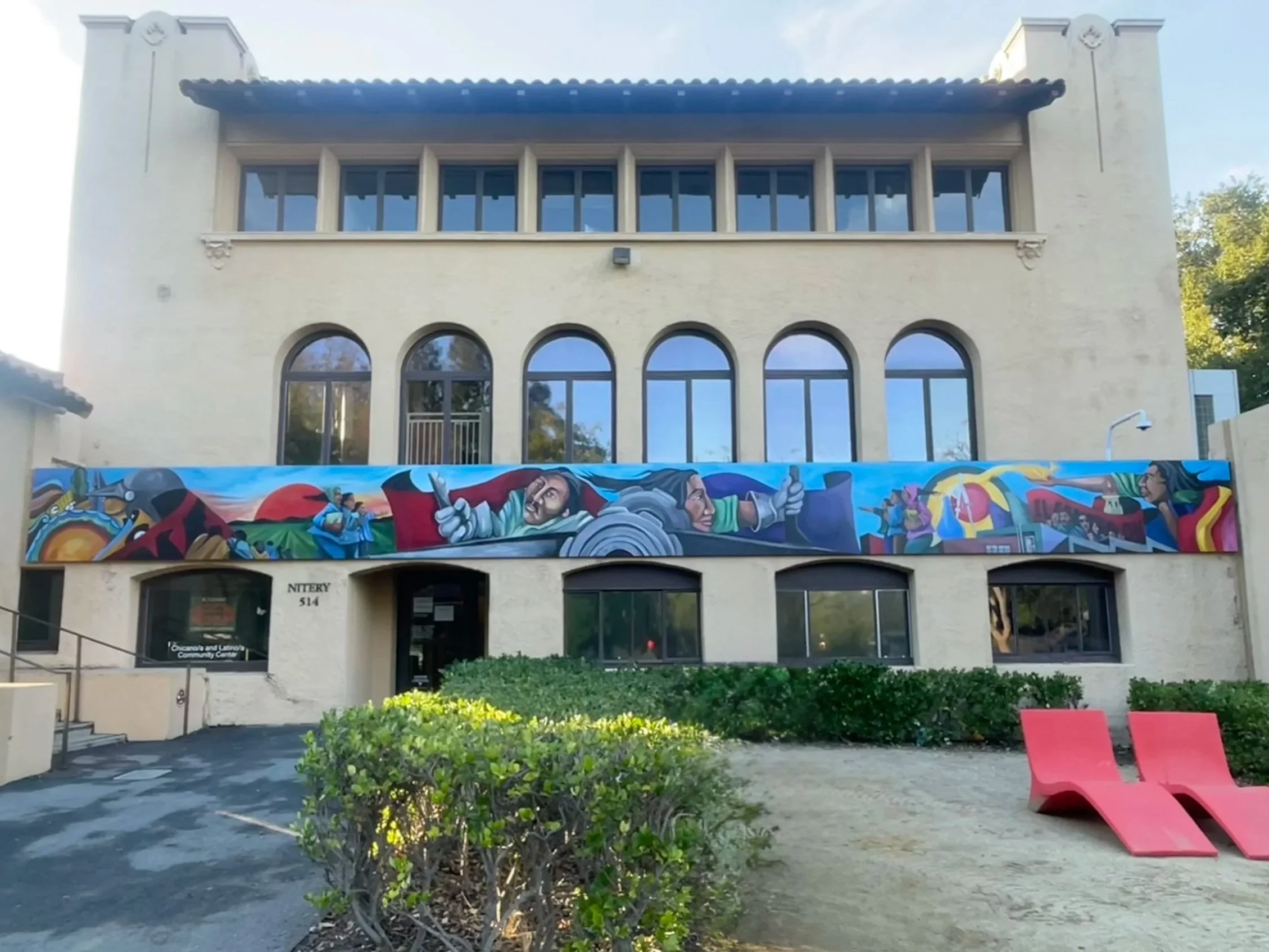
Malaquías Montoya created the mural at El Centro Chicano y Latino during his time as a visiting instructor in the Stanford Workshop on Social and Political Issues (SWOPSI) program at Stanford. The mural was a collaborative project with Stanford students, blending artistic expression with social justice education and engaging students in art as a tool for activism. The effort to paint a mural for El Centro was part of Montoya’s commitment to the Chicano Movement broadly, to “present a visual side of the Chicano Movement, using art as an educational tool to instruct and reflect is the role of the artist. To Stanford Chicanos, Malaquias offered “art, like pre-med, engineering, pre-law is important because we have a tradition of great art. It is necessary that we maintain that part of our heritage.” (La Onda, Volume IV No. 4, 1979-80)
Beginning on the left side of the mural, the composition presents a subtle confrontation between an Indigenous Mesoamerican figure, likely Aztec, and Spanish conquistadors. Though only partially depicted, the visual cues are clear: an Aztec warrior in a jaguar headdress holds a green wooden macuahuitl, a weapon lined with obsidian blades capable of severing limbs. This colorful, organic figure sharply contrasts with the grey-toned Spanish soldier, shown in a side-profile wearing a steel morion helmet and holding a metal staff and sword. The juxtaposition of Indigenous regalia and European armor evokes the violent cultural collision following the 1492 encounter of the arrival of the Spanish to the Americas.
These two figures are surrounded by what appear to be scrolls or banners inscribed with fragments of history. A prominent black-and-red United Farm Workers (UFW) banner transitions the viewer into the next scene: a vast agricultural field evocative of California’s Central Valley, where the Chicano and farmworker movements gained powerful momentum. In the foreground, a line of Latino laborers—seen only from behind—march toward the fields, their worn clothing signaling their working-class identity. Under a dramatic sunset framed by distant mountains, the mural shifts toward the center, where three farmworkers appear: a woman and a man each holding books, and another man pointing forward. These figures are mirrored symmetrically on the opposite side of the mural, forming a visual anchor for the central scene.
At the center of the mural, a Latino man with a mustache stands alongside a second figure, likely a woman of color with long black hair, both dressed in green uniforms and engaged in industrial work. Equipped with metalworking gloves, they operate heavy machinery, highlighting the strength and dignity of working-class labor. This scene evokes the iconography of Diego Rivera’s Detroit Industry Murals (1932-33), where workers are pulling levers on machines; however, here, it centers on Latino workers as agents of production. The duality between agricultural and industrial labor underscores both the dignity and the endurance of working-class communities, grounding the mural in a narrative of collective struggle and contribution.
At the far-right end of the mural, the scene shifts to the present day, depicting university buildings and a group of student protesters. A striking red flag with the words “El Centro Chicano” appears prominently in the background, anchoring the image in its contemporary setting. Central to this panel is a striking spherical sun-like figure, in front of which stands a person who appears to be either controlling or fueling its fire, guided by a compass. The scene serves as a reminder that today’s students stand on the shoulders of past generations shaped by conquest, labor, and collective struggle. –Mauricio E. Ramírez
Interior Murals
-
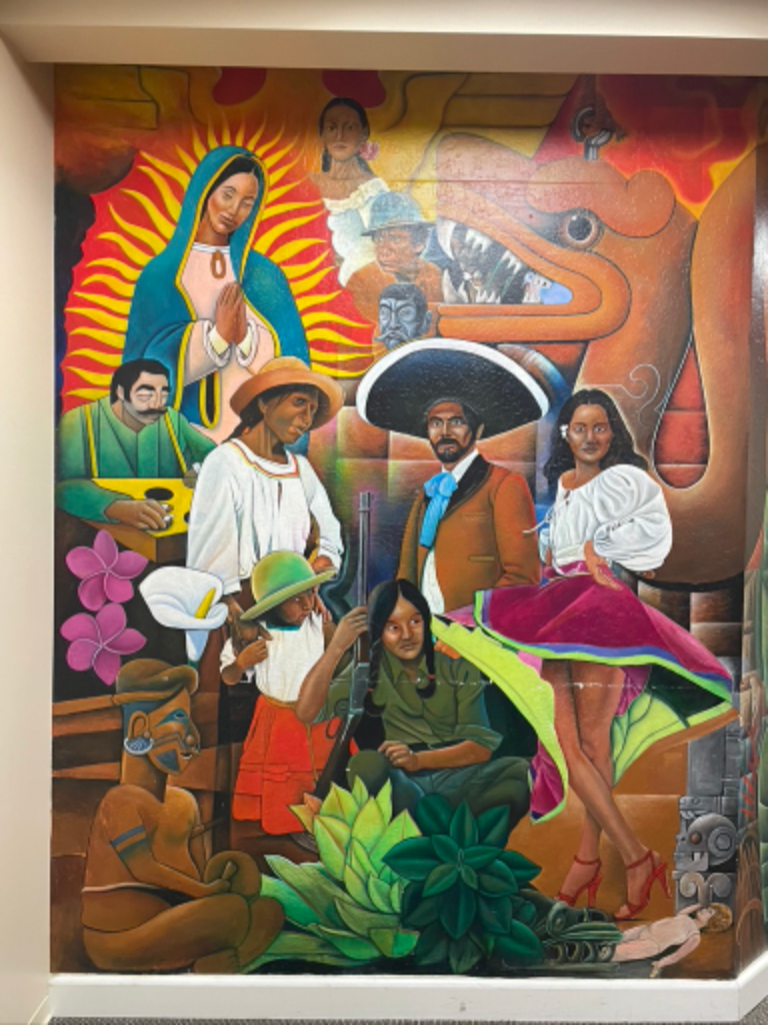
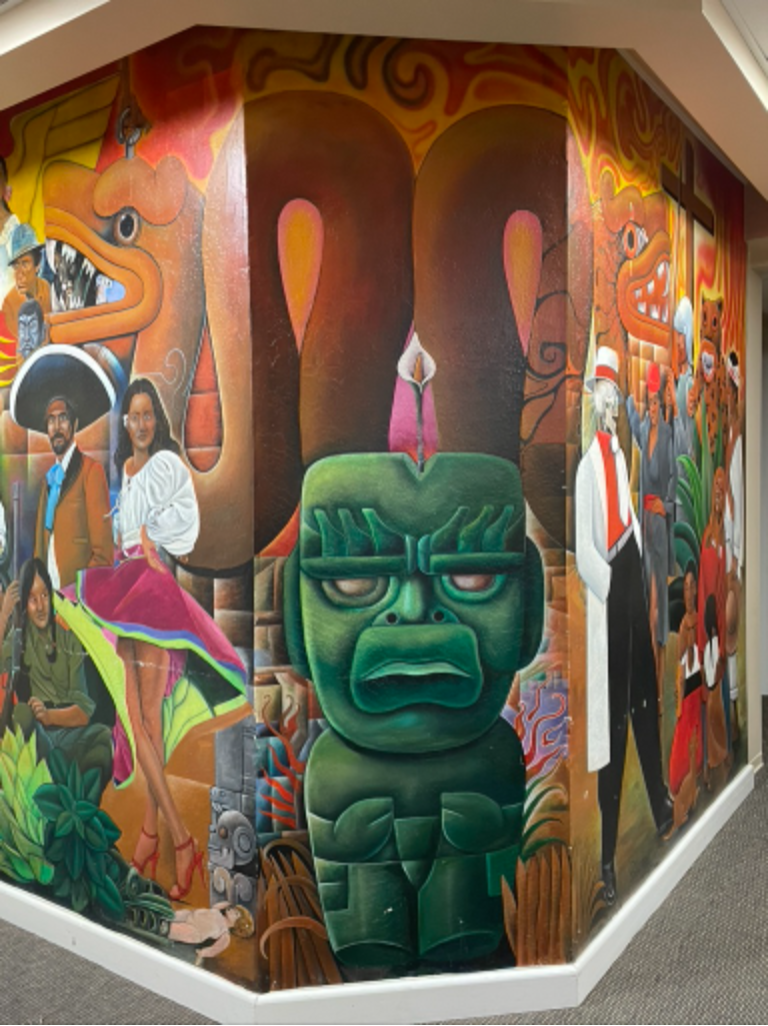
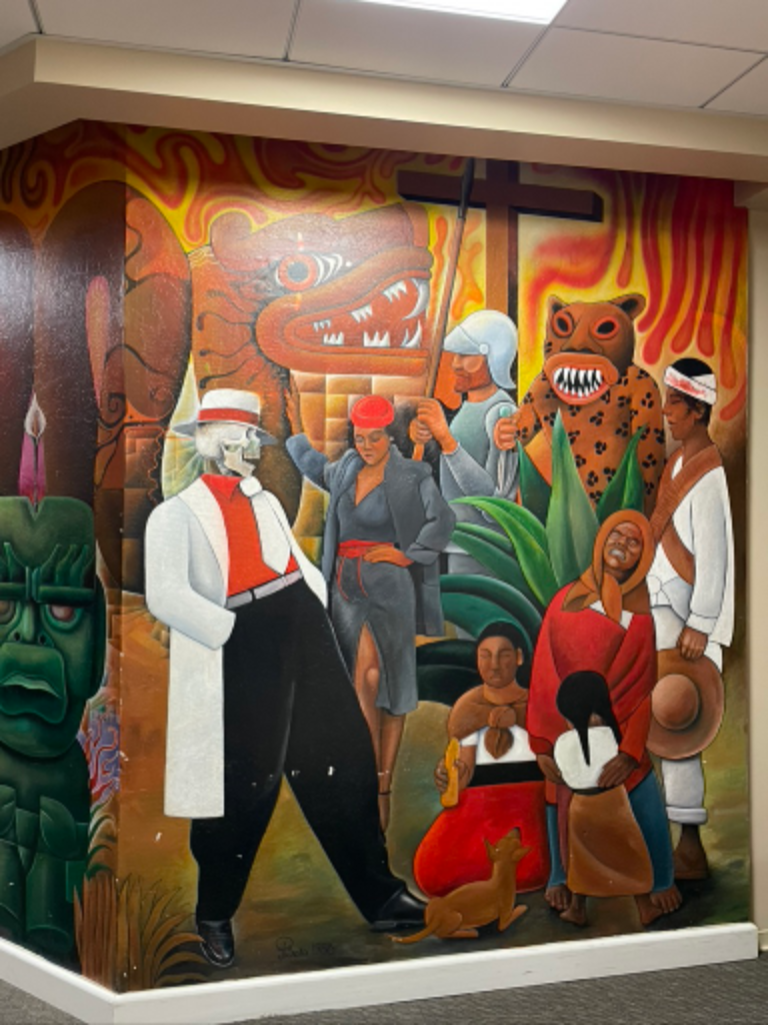
Pablo Soto’s tri-panel mural at El Centro presents a sweeping cosmology of Latino, Chicano, and Mexican identities through layered iconography of resistance. Moving from right to left, the mural stages a dense visual narrative shaped by Indigenous symbols, colonial violence, and revolutionary memory.
In the rightmost panel, Soto confronts viewers with the enduring trauma of colonization. A skeletal figure wearing a white, black, and red zoot suit stands beside a dancing woman dressed in 1940s-era clothing. This composition evokes the zoot suit era while situating Chicano resistance within a broader historical context. Behind them, flames rise as a conquistador brandishes a sword under a Christian cross, which are indicative symbols of the 1519 Spanish conquest and forced Catholicism in Latin America. Yet, beside him, a jaguar dancer resists visually and spiritually, evoking the strength of pre-Hispanic warriors. At the base, campesinas and a barefoot child kneel in sorrow, but one woman clutches a maize cob, signifying sustenance. Soto layers time and space, refusing linear storytelling in favor of a cyclical, decolonial memory.
The central panel anchors the mural with an Olmec-style green head, crowned by a calla lily. Twin serpent heads, recalling Quetzalcoatl, frame the space and signal regeneration and sacred dualities. Positioned at a corner junction, this panel serves as a ceremonial threshold between the past and the present, where serpent motifs extend into adjoining panels, binding them together. Soto frames indigeneity not as past, but as an ontological force shaping Latino identity.
The leftmost panel brings the narrative into the modern era. La Virgen de Guadalupe presides over a revolutionary tableau. Below her, a man dressed as Emiliano Zapata stands beside a woman in a magenta skirt and heels, an image of feminine confidence and resistance. A guerrillera crouches with a rifle, and a girl looks up, highlighting intergenerational struggle and learning. Behind the girl, a campesina in red and white radiates strength, while native plants like agave and nopal root the figures in the land. The serpent, now bearing in the faces of ancestors and martyrs, suggests that revolutionary energy is born from historical memory.
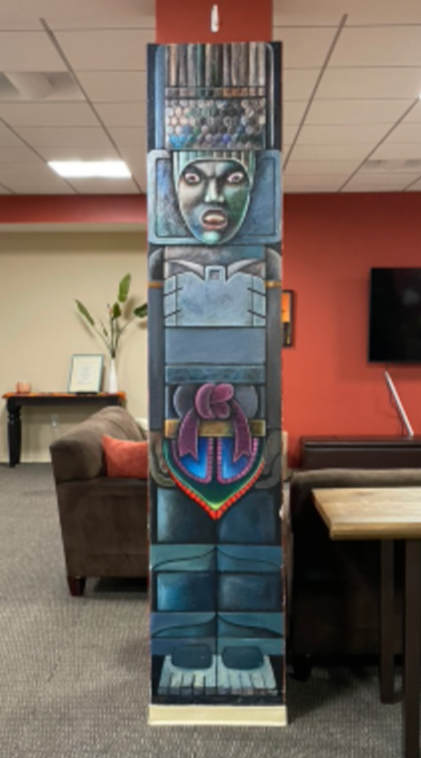
Adjacent to this panel, Soto painted a vertical column that resembles a Toltec Atlantean warrior from Tula, Mexico. The vertical column within the space extends Soto’s mural within the space. This image depicts a frontal, stone-like figure with a stern face, a detailed headdress, and squared limbs. Its rigid symmetry and stylized armor evoke the architectural guardianship of ancient temples, now recontextualized as cultural protectors within the communal lounge of El Centro. Situated at the heart of El Centro, this warrior from the Toltec era evokes the spirit of the Chicano Movement, serving as a visual anchor for themes of cultural resistance and the ongoing fight for self-determination and educational equity.
Soto’s mural serves as both pedagogy and protest. The mural rejects dominant narratives of conquest and assimilation, replacing them with a regenerative vision rooted in Indigenous cosmology and revolutionary history. For El Centro, the work serves as an invitation to remember the past while also reimagining the future. –Mauricio E. Ramírez

-
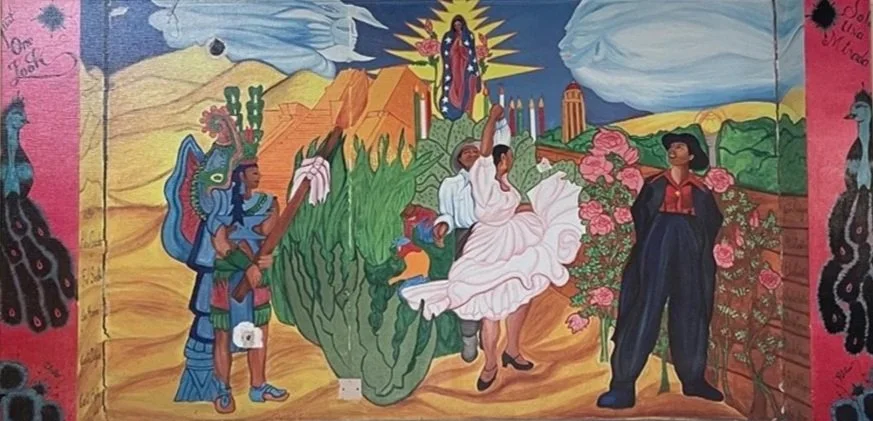
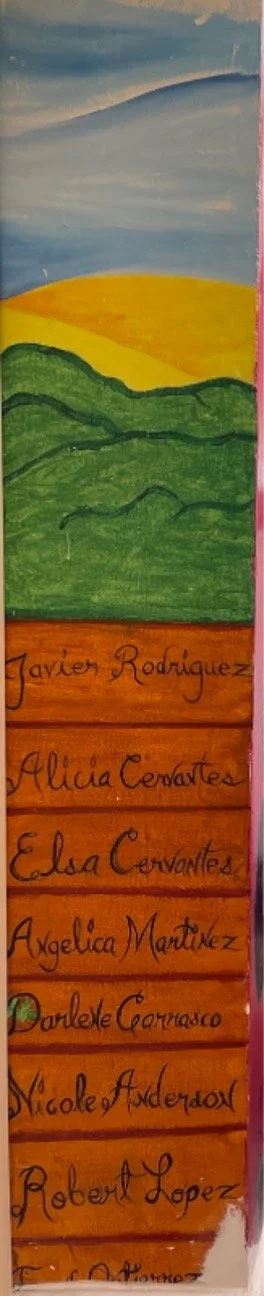
Juana Alicia’s early mural, formerly painted inside the walls of El Centro, constitutes a significant visual meditation on Chicano and Mexican identity. Produced in collaboration with Stanford University students, the composition engages feminist, Indigenous, and diasporic frameworks, situating these within broader histories of the Chicano Movement and cultural affirmation.
Dominating the upper and central composition, La Virgen de Guadalupe presides over the scene as a figure of spiritual guardianship. Positioned above a landscape suggestive of the U.S.–Mexico border, she mediates between two distinct geographies: Mexico, marked by a Mesoamerican ruin, and California, identified by the iconic profile of Stanford’s Hoover Tower. The figure of La Virgen both references Catholic devotional traditions and indexes her strategic reappropriation within Chicanx cultural politics as a symbol of decolonial and feminist agency.
On the left, a Mexica warrior emerges against a backdrop of desert terrain, a Mesoamerican pyramid, a maguey plant, and a nopal cactus, visual markers that anchor the composition in precolonial heritage and geographic rootedness. At the center, a couple performs ballet folklórico, a scene that embodies cultural preservation, blending the past with the present. Behind them, campesino laborers harvest agricultural fields, invoking the histories and ongoing realities of farmworker labor in the United States.
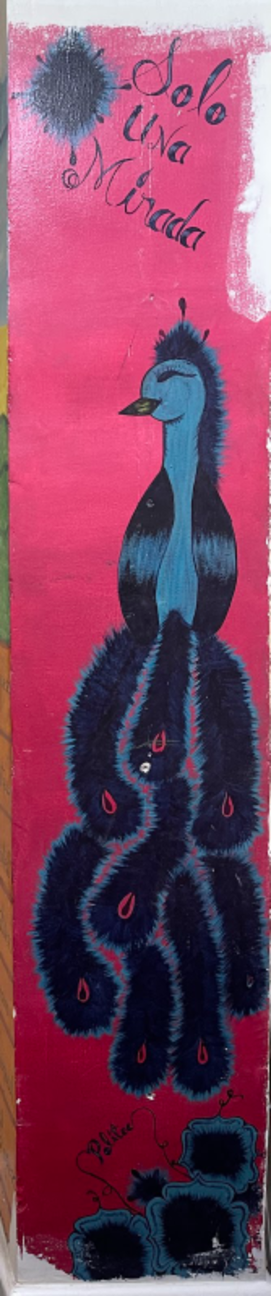
The right panel features a Pachuco figure in a zoot suit, posed amidst roses and cultivated rows. This figure signifies Chicano political agency and resistance to cultural erasure, his stance amplified by the visual citation of Luis Valdez’s Zoot Suit, here reimagined in the iconic bold black and red zoot suit. The cursive, English and Spanish inscription Solo una Mirada (Just One Look) serves as an interpretive prompt, inviting viewers to engage beyond surface readings. Through its integration of iconographic, historical, and political references, the mural articulates a decolonial feminist vision that affirms cultural survival and reclaims representational space. –Mauricio E. Ramírez
Visit El Centro Chicano y Latino’s Our Murals page for additional images, details, and insights from the artist Juana Alicia.
-
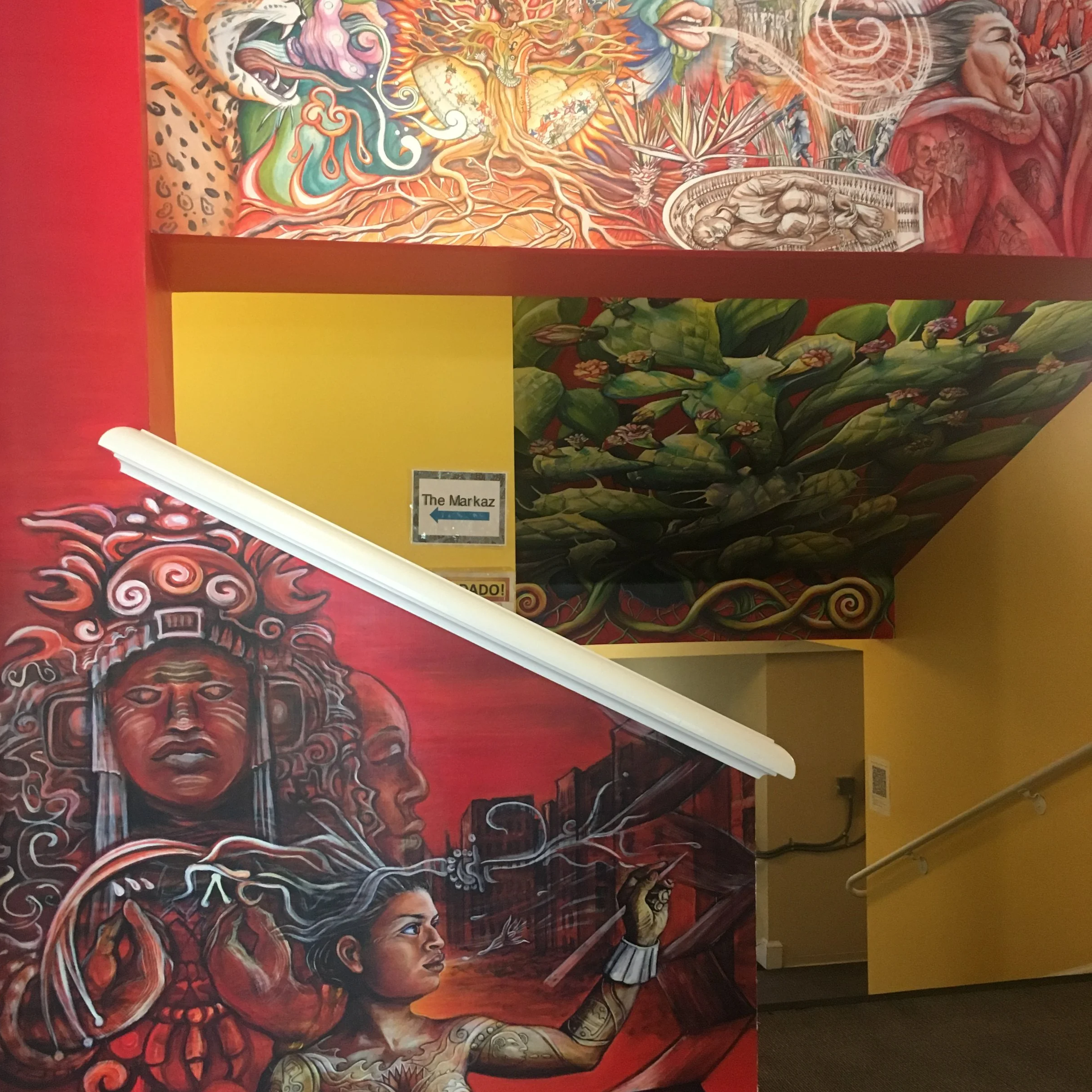
The Spiral Word: El Codex Estánfor unfolds across three segments within El Centro Chicano y Latino’s entryway. El Centro commissioned the mural following the 2006 renovation-related destruction of Just One Look/Una Sola Mirada, a mural painted in 1984 by Juana Alicia and students.
During the creation of The Spiral Word, Alicia surveyed the students to learn what imagery they most wanted to see reflected in the mural, asking questions about images and symbols that reflected Chicano/Latino thought, and requested that students share the names of authors and thinkers, quotes, as well as images and photographs for consideration to be included in the mural. Alicia also invited students to participate in the project in support roles that spanned studio assistance, documentation, research, administration, and community education. The creation of the mural coincided with a period in El Centro’s history when there was concern about the center’s reach to the broad range of identities and experiences represented within the Latino community at Stanford. As a result, the mural’s imagery and thematics draw from a multi-ethnic cultural and historical lexicon. The mural is emblematic of Alicia’s stylistic signatures, featuring densely-layered narrative compositions that draw upon motifs from the natural world and utilize color to amplify the work’s symbolic impact.
As the viewer approaches the mural, a partial wall segment features “Mayan Scribe,” depicting a young woman inscribing a codex as she sits surrounded by masks and sculptures from ancient cultures and contemporary ruins. Flourishes of wind and speech scrolls suggest that the masks and sculptures offer guidance to her. On a horizontal span above the stairwell, a mural featuring five sections unveils the contents of the scribe’s codex. “Genesis”depicts the creation story of the Maya from the Popul Vuh. The narrative continues in “Conquest and Slavery,” which details the violent extraction of labor through the enslavement of indigenous and African peoples and the destruction of knowledge. The third segment, ‘Resistance and Revolution,”is anchored by the figure of Mercedes Sosa, whose voice and garments carry representations of revolutionaries and figures fighting for justice, such as José Martí, the Zapatistas, women in Guatemala, Violeta Parra, Assata Shakur, Gabriela Mistral, Las Mujeres de Negro, John Carlos and Tommie Smith, and Comandante Ramona. The composition then depicts “Gemelos,” the warrior twins from the Popul Vuh as the conflicted identities of a gangster and dreamer across a backdrop wrought by the impacts of capitalism and climate change. The composition concludes with imagery of nature healing itself and a contemporary scribe who looks toward the past. The third segment, installed over the stairwell, “Nopal de Resistencia y Raices,” depicts cacti as a symbol of the ability to thrive within an unforgiving environment, supporting life and beauty while remaining rooted in the earth. –Mary Thomas
© 2026 Rose Salseda